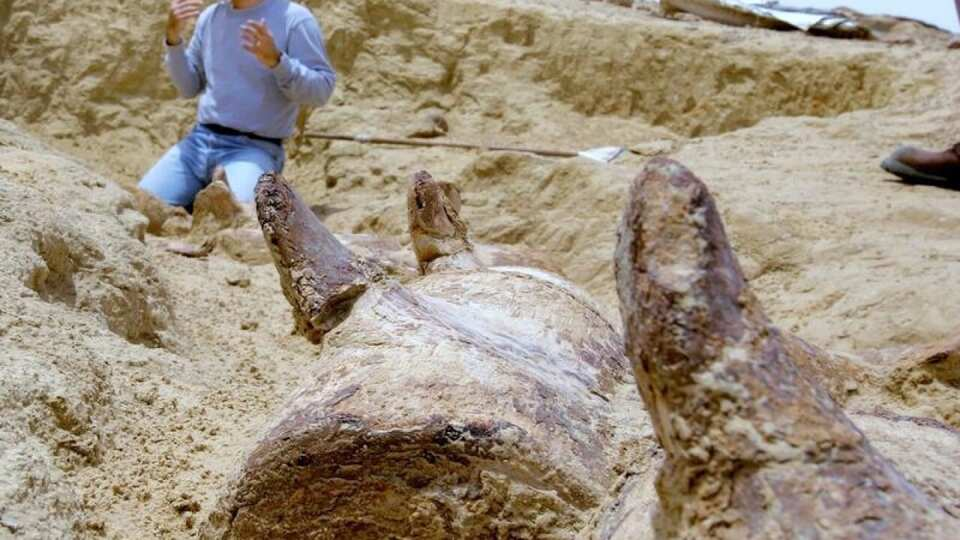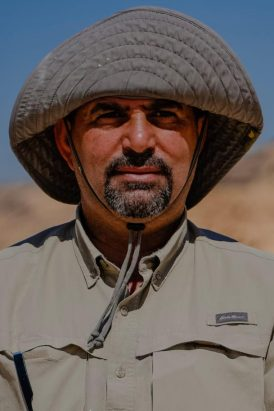
Iyad Zalmout in the field wearing sun hat and field shirt

Dr. Iyad Zalmout

National Geographic Explorer · SGS Consultant · U-M Research Affiliate

National Geographic Explorer · Since 2009

PhD, Vertebrate Paleontology, University of Michigan
Vertebrate paleontologist uncovering Afro-Arabian deep time — from Oligocene primates and Eocene whales to Pleistocene hominin dispersal. Research Director at the Saudi Geological Survey and Research Affiliate at the University of Michigan Museum of Paleontology.

  • Saadanius hijazensis · Nature 2010
  • National Geographic Explorer since 2009
  • 81+ publications · Afro-Arabian field discoveries
  • Al Wusta hominin · U-M Research Affiliate
Publications
81
Publications
Reads
78,138
Reads
Citations
3,097
Citations
zalmouti@umich.edu
Scroll downScroll down to explore the site

Layer 1 · Present Day

The Crust

SGS Research Director · U-M Research Affiliate

At the surface of deep time, Iyad S. Zalmout serves as Research Director and Consultant at the Saudi Geological Survey Paleontology Section in Jeddah and Research Affiliate at the University of Michigan Museum of Paleontology. In 2021, the SGS team he advised unveiled the Kingdom's most complete Eocene archaeocete—a ~37 Ma whale graveyard in the Al-Rashrashiyah cliffs of Al-Jouf—alongside 81 publications and decades of Afro-Arabian field discovery.

  • Research Director, SGS Paleontology (2015–Present)
  • Homo sapiens finger bone · Al Wusta, 2016
  • Western Nefud palaeolakes · Pleistocene wetlands, 2017
  • Lost Worlds of Arabia · Green Arabia dispersal
  • Umm Jirsan lava tube · Harrat Khaybar, 2024
  • Madagascar Cenozoic fieldwork · Karen Samonds lab
  • Inabtanin alarabia · Jordan Maastrichtian, 2024
  • Elephas recki · Nafud Desert, 2014–2017
  • Research Affiliate, U-M Museum of Paleontology
  • PhD Vertebrate Paleontology, University of Michigan
Layer 2 · 2009 · Oligocene

The Shumaysi Layer

Saadanius hijazensis · SGS-UM 2009-002

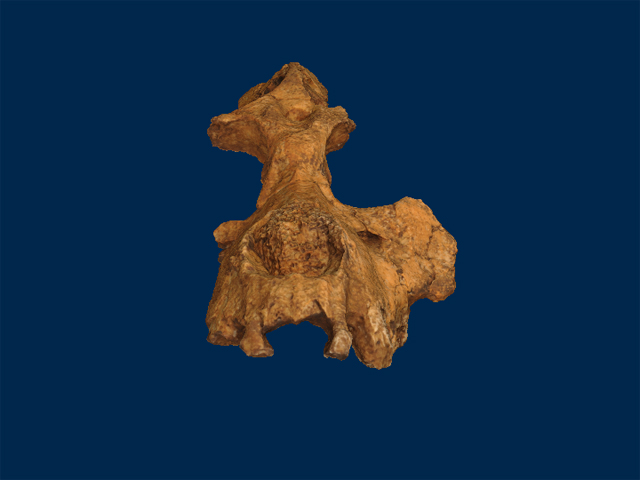
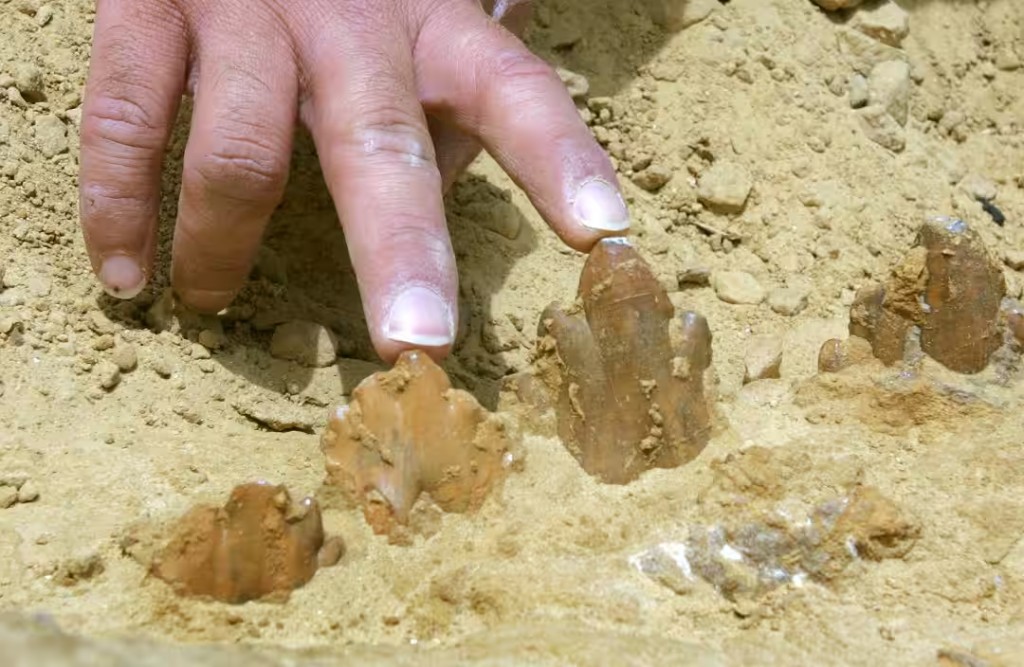
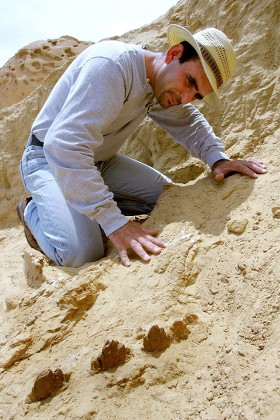
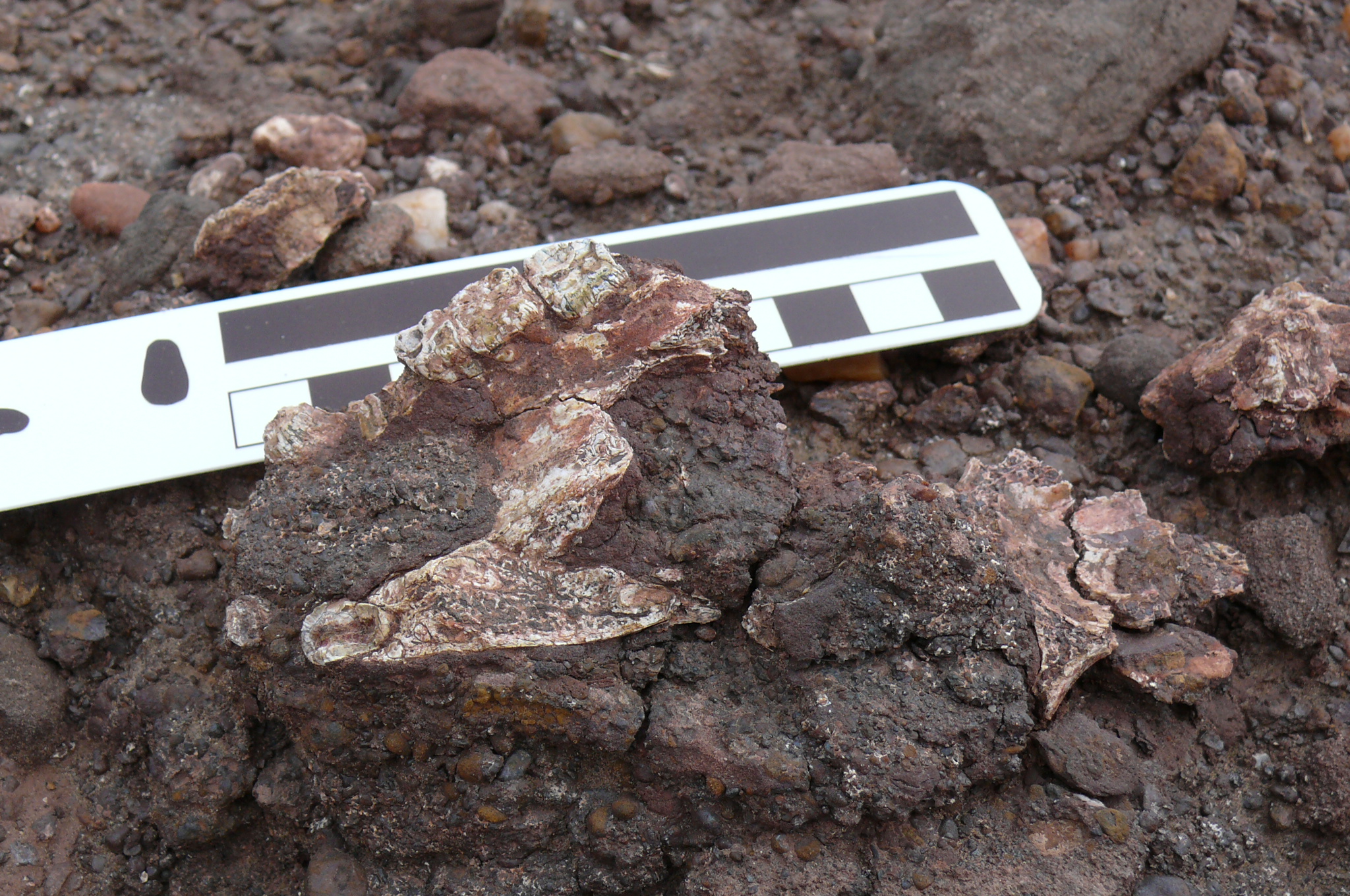
In February 2009, fieldwork in the Shumaysi Formation at Harrat Al Ujayfa uncovered cranium SGS-UM 2009-002—a 28–29 Ma catarrhine preserving the tubular ectotympanic, placing Saadanius at the threshold of the ape–Old World monkey split.

Cranium of Saadanius hijazensis (SGS-UM 2009-002) in situ, Shumaysi Formation, February 2009
Iyad S. Zalmout · U-M Museum of Paleontology · CC BY-SA 3.0 · CC BY-SA 3.0
  • Holotype SGS-UM 2009-002
  • Nature 466, 360–364 (2010)
  • ~15 kg stem catarrhine
  • Shumaysi Formation geology · Wikimedia Commons

Layer 3 · 2000s · Eocene

Tethys Ocean Desert

Archaeocetes · Wadi El Hitan, Egypt

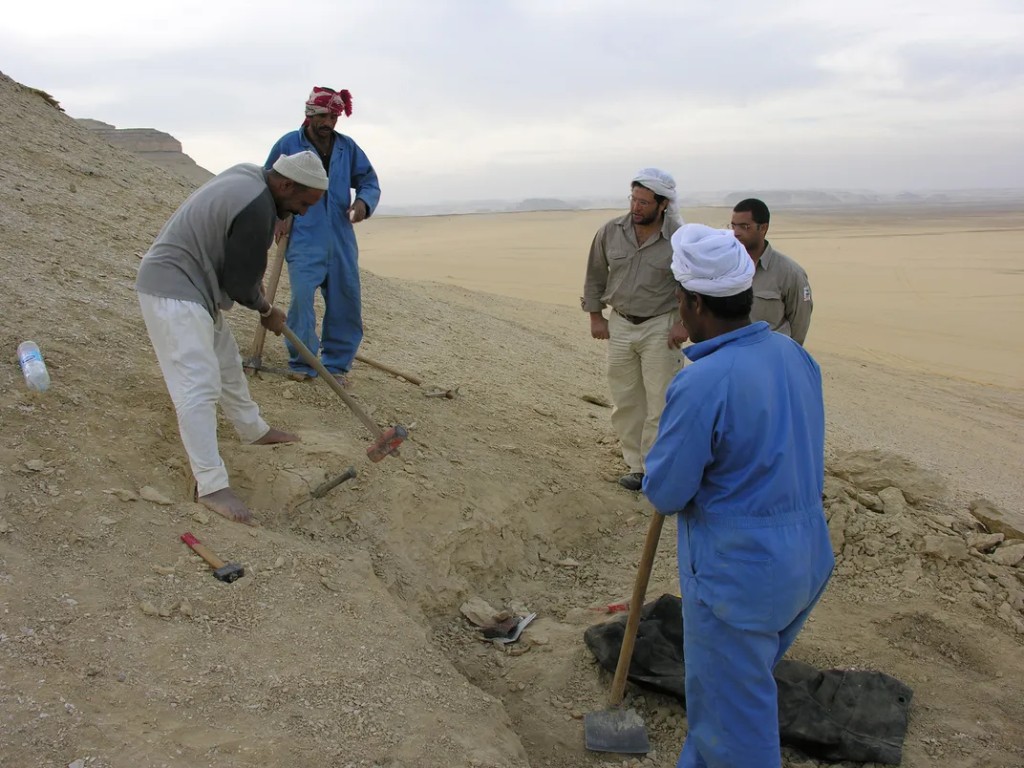
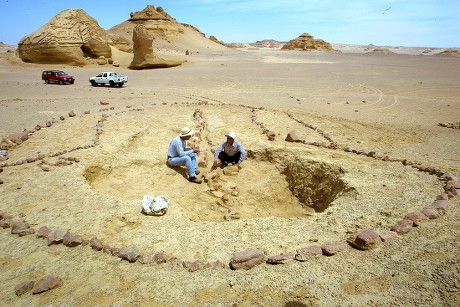
At Wadi Al Hitan—Egypt's UNESCO Whale Valley—Iyad Zalmout helped uncover the evolutionary bridge from foot-powered to tail-powered swimming. In 2007, the team unearthed Aegicetus gehennae, a nearly complete late Eocene protocetid (~39 Ma) described with Philip Gingerich and Mohammed Antar. Field seasons also recovered 16-meter Basilosaurus isis specimens among hundreds of archaeocete skeletons in the desert pavement.

Iyad Zalmout and Gebali Abu Kheir at a Basilosaurus isis excavation in Wadi Hitan, Egypt, April 2005
Mike Nelson / EPA · Editorial
  • Aegicetus gehennae · Wadi Hitan, 2007
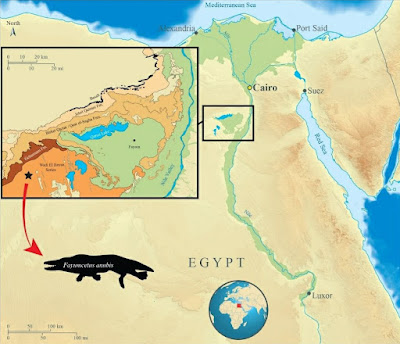
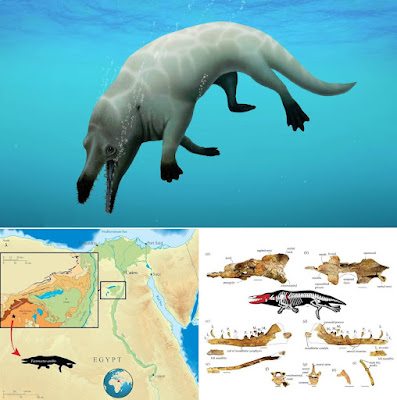
  • Phiomicetus anubis · Fayum Depression, 2021
  • Basilosaurus isis · Ad-Dahikiya, Jordan 1998
  • Basilosaurus isis excavation · April 2005
  • Basilosaurus stomach contents · whale-on-whale predation
  • Nat Geo grant · Siwa Oasis, Egypt
  • Nat Geo Magazine · Valley of the Whales, Aug 2010
  • Shark Teeth Trail · Khurais Dammam Formation
  • PLOS ONE · Nature Middle East (2019)

Layer 4 · Early Life

The Bedrock

Yarmouk · Michigan · Gingerich

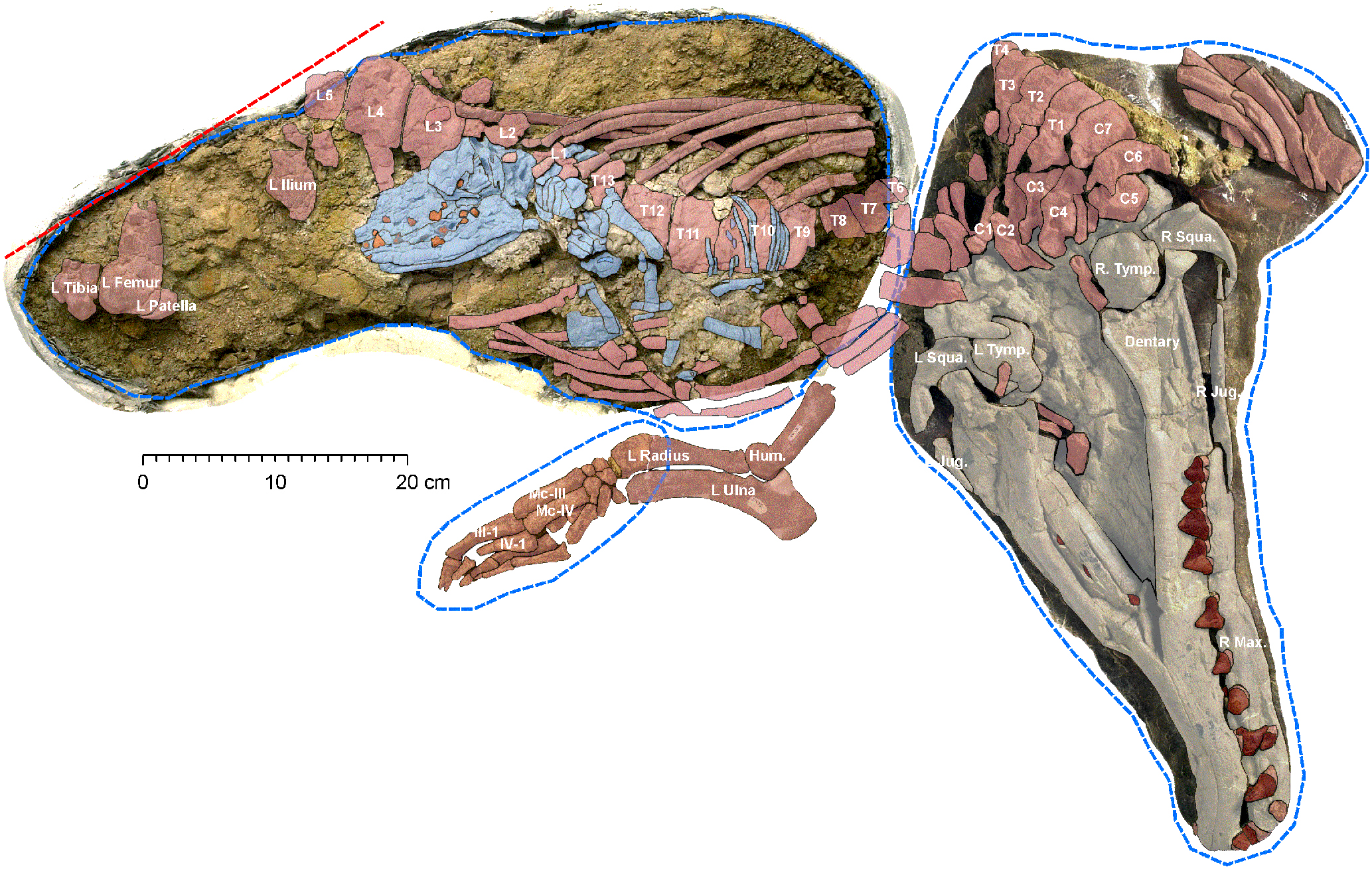
Academic bedrock formed under Philip Gingerich at Yarmouk University and the University of Michigan. As U-M postdoctoral scholar, Iyad Zalmout co-authored the discovery of Maiacetus inuus in Pakistan—a pregnant archaeocete with a near-term fetus positioned for head-first, land-mammal birth, proving early whales still came ashore to deliver young.

Adult female Maiacetus inuus (red) with near-term fetus in utero (blue), GSP-UM 3475 — Pakistan holotype
Gingerich et al. 2009, PLOS ONE Fig. 2 · CC BY 2.5 · Wikimedia Commons · CC BY 2.5
  • Walking Whales · Ad-Dahikiya, Jordan 1998
  • Maiacetus inuus · Pakistan, 2000
  • First fetal skeleton of an archaeocete
  • PLOS ONE · U-M Museum of Paleontology

Scientific Impact

PhD, Vertebrate Paleontology, University of Michigan
Consultant · Saudi Geological Survey Paleontology Section

0

Publications

0

ResearchGate Reads

0

Citations

Expertise

  • Vertebrate Paleontology
  • Systematics
  • Marine Mammals
  • Archaeocetes
  • Primate Evolution
  • Sedimentary Basins
  • Taxonomy
  • Paleoenvironments
  • Biodiversity
  • Field Geology
  • Afro-Arabian Paleontology
  • Micropaleontology

National Geographic Society

Explorer since 2009

National Geographic Society grantee for field research on Eocene whales and sea cows in Egypt's Western Desert—and featured in the August 2010 magazine cover story on whale evolution at Wadi Hitan, the same year as the Shumaysi Formation discovery of Saadanius hijazensis.

Grantee · November 2009November 2010

Eocene Whales and Sea Cows of Siwa Oasis, Western Desert of Egypt

Siwa Oasis, Western Desert, Egypt

Career Stratigraphy

From Yarmouk University field assistant to Research Director at the Saudi Geological Survey and Research Affiliate at the University of Michigan.

  1. February 2015 – Present

    Research Director / Consultant

    Saudi Geological Survey · Paleontology Section

    Jeddah, Saudi Arabia

  2. Present

    Research Affiliate

    University of Michigan · Museum of Paleontology

    Ann Arbor, Michigan

  3. November 2009 – November 2010

    Explorer · Grantee

    National Geographic Society · Explorer Program

    Siwa Oasis, Western Desert, Egypt

  4. September 2012 – June 2014

    Research Assistant

    King Saud University · Department of Zoology

    Riyadh, Saudi Arabia

  5. September 1995 – December 1996

    Research Assistant

    Yarmouk University · Earth and Environmental Sciences

    Irbid, Jordan

Flagship Publications

Eight highlights from 81 works — explore the full catalog below.

2010Wikimedia Commons

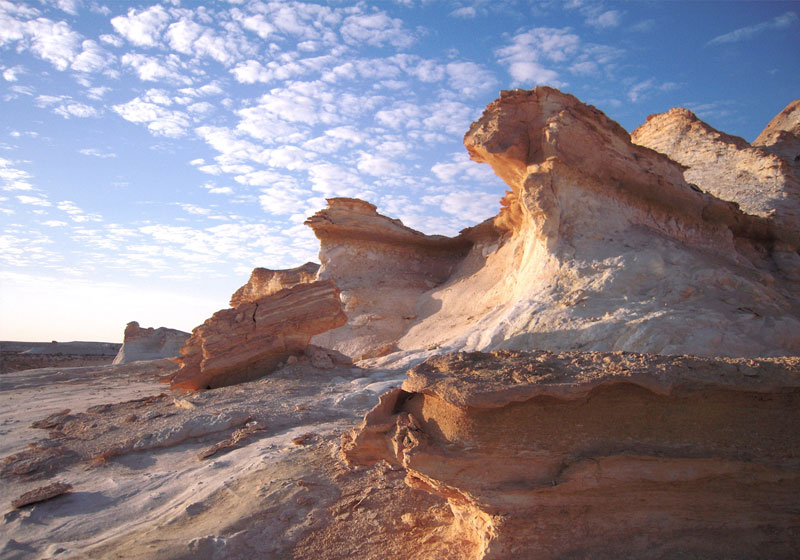
Shumaysi Formation 001

Field geology near Saadanius locality · photo by Iyad Zalmout · CC BY-SA 3.0

2002Khammash Architects · The Jordan Times Weekender

Walking Whales

Basilosaurus isis · Ad-Dahikiya, Jordan 1998 · first Eocene marine mammal

2025Nature

Recurrent humid phases in Arabia over the past 8 million years

Central Arabian speleothem paleoclimate

In plain termsInteractive fossil-to-life transition — Oligocene primate cranium.

Biomorphic Transition

WebGL erosion shader dissolving the Saadanius cranium in situ into its living Oligocene reconstruction. Move your cursor for liquid-glass refraction ripples.

In plain termsA ~28-million-year-old ape relative — near the split between apes and Old World monkeys.

Cranium of Saadanius hijazensis (SGS-UM 2009-002) in situ with palate and teeth facing upward, Shumaysi Formation, February 2009
The cranium of Saadanius hijazensis as Zalmout found it in the Shumaysi Formation—teeth exposed in iron-rich conglomerate while searching for fossil whales and dinosaurs.Iyad S. Zalmout · U-M Museum of Paleontology · CC BY-SA 3.0 · Full resolution

Phys.org · University of Michigan · 14 July 2010

Fossil find puts a face on early primates

Saadanius hijazensis · SGS-UM 2009-002 · 2829 Ma

When Iyad Zalmout went looking for fossil whales and dinosaurs in Saudi Arabia, he stumbled upon a skull that reframed the last common ancestor of apes and Old World monkeys. The Oligocene catarrhine lacks specialized features of modern apes and monkeys, placing the ape–monkey split several million years later than previously thought.

  • Stem catarrhine at the ape–Old World monkey split (~28–29 Ma)
  • Tubular ectotympanic — like apes and Old World monkeys
  • Projecting snout, tall face, long narrow nasal bones, broad cheek teeth
  • Male individual: no nasal sinuses or enlarged canines typical of later males
  • Basal features: longer face, no frontal sinus
  • Puncture wounds from a large predator may have killed the individual
  • Baboon-like snout, not gibbon-like button nose
  • Arabia still attached to Africa before Red Sea rifting
  • Shumaysi Formation age bracketed by dated volcanic ash layers
  • Discovered during SGS–U-M joint field expedition

Within minutes, I found teeth sticking out of the ground, and when I realized what they were I was shocked. I had worked with Phil on terrestrial mammals in the Bighorn Basin, and my first look at the size and shape of these teeth told me I had found a primitive primate.

Iyad S. Zalmout
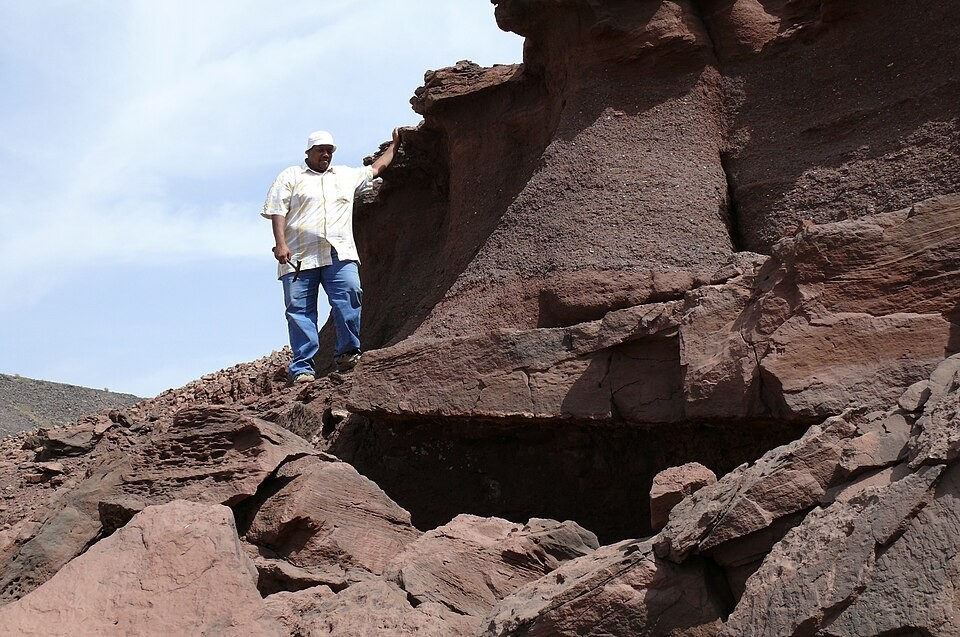
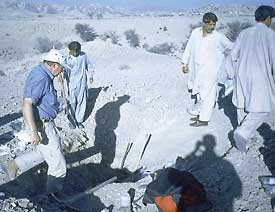
SGS geologist Mohammad Ali examines red sandstones and siltstones of the Shumaysi Formation near the Saadanius hijazensis fossil locality

Shumaysi Formation (Ash Shumaysi Formation) · Stratigraphy

The Shumaysi Layer

Red sandstones and siltstones truncated by channels of quartz pebble conglomerate and occasionally bands of ironstone. SGS geologist Mohammad Ali examines the formation near the Saadanius hijazensis fossil locality—where Zalmout found holotype SGS-UM 2009-002 on 17 February 2009.

Red sandstones and siltstones of the Shumaysi Formation—truncated by quartz pebble conglomerate channels and ironstone bands—near the Saadanius hijazensis locality at Harrat Al Ujayfa. The formation anchors the holotype in dated Oligocene strata bracketed by volcanic ash layers and associated mammal biochronology.

Photograph
Iyad S. Zalmout · 17 February 2009
Image: Iyad S. Zalmout · UMMP · Near Saadanius locality, Shumaysi Formation, western Saudi Arabia
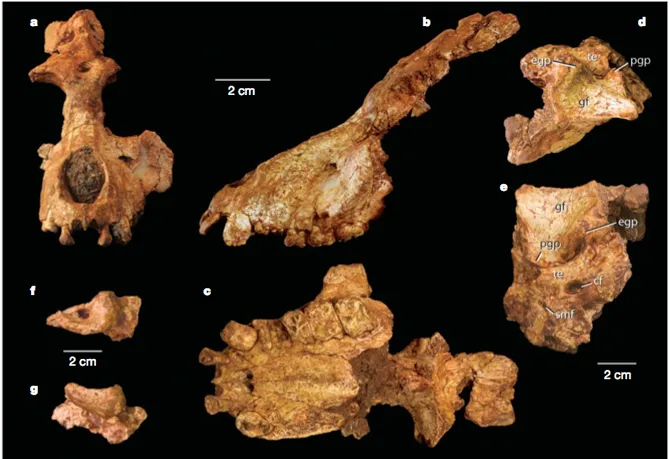
Holotype partial cranium of Saadanius hijazensis — frontal, lateral, palatal, and detailed anatomical views (a–g) with tubular ectotympanic and glenoid fossa labeled

WIRED · Science News · 14 July 2010

Apes, Old World Monkeys May Have Split Later Than Thought

By Bruce Bower

A slope-faced, big-toothed primate from western Saudi Arabia recalibrates when apes and Old World monkeys diverged. The ~28–29 Ma fossil suggests the split occurred between 29 and 24 million years ago—later than a 2004 DNA estimate of 34.5–29.2 Ma. At 1520 kg, Saadanius hijazensis lived shortly before the last common ancestor of hominoids and cercopithecoids.

Fossil-based split
24–29 million years ago
DNA estimate (2004)
29.2–34.5 million years ago (2004 DNA analysis)

This is wonderful discovery, a real missing link that fills in a gap in our understanding of the timing and pattern of anatomical change involved in the evolution of Old World monkeys and apes.

John Fleagle, Stony Brook University

Saadanius strikingly matches her prediction.

William J. Sanders on Brenda Benefit’s 1993 model of the ape–monkey common ancestor

Nature holotype figure: slope-faced mosaic of ancestral snout and broad cheek teeth with derived tubular ectotympanic (te), entoglenoid process (egp), and glenoid fossa (gf)—each scale bar 2 cm.

Image: Zalmout and Sanders · Nature 2010
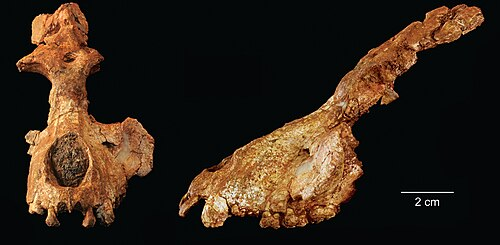
Frontal and lateral views of the partial skull of Saadanius hijazensis with 2 cm scale bar

Wikinews · 16 July 2010

Researchers discover last common ancestor of apes and monkeys

Paleontologist Iyad Zalmout of the University of Michigan discovered Saadanius hijazensis near mecca, western saudi arabia—a partial skull that may sit near the last common ancestor of apes and Old World monkeys. Tree-dwelling catarrhines lived here when Arabia had not yet rifted from Africa.

Fossil estimate
24–29 million years ago
Genetic estimate
29.2–34.5 million years ago (2004 DNA analysis)

Partial skull of Saadanius hijazensis—frontal and lateral views showing the long face, upper dentition, and puncture wounds that may record predation in the Oligocene canopy.

Image: Iyad S. Zalmout / Wikinews
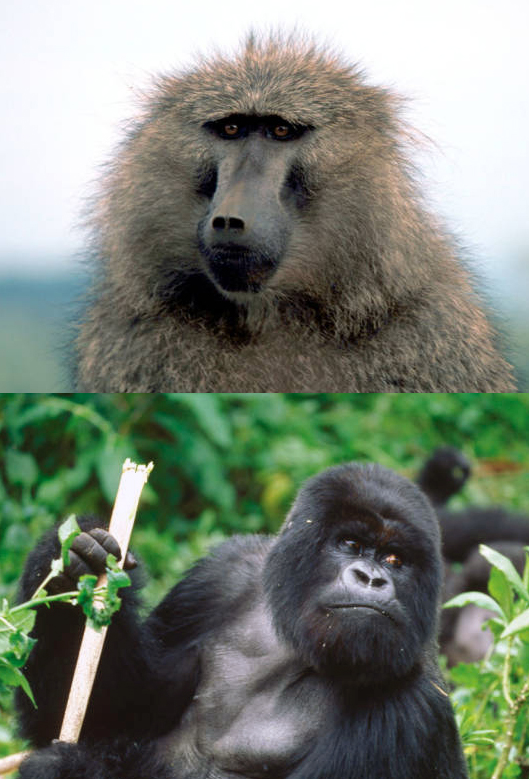
Modern Old World monkey (baboon) and ape (gorilla) illustrating crown catarrhine diversity

UMORF · University of Michigan Museum of Paleontology · 27 March 2020

Saadanius and the split between old world monkeys and apes

By William J. Sanders, PhD

Crown catarrhines—Old World monkeys, apes, and humans—diverged from stem catarrhines in Afro-Arabia. In 2009, a U-M–Saudi Geological Survey team led by Dr. Iyad Zalmout recovered a partial cranium from the Shumaysi Formation, named for the Arabic collective term for apes and monkeys.

Geneticists predicted ape–Old World monkey divergence at 34.5–29.2 myr; paleontologists estimated late Oligocene 25–23 myr. Morphologists reconstructed a short-faced crown ancestor; paleontologists argued for a long, projecting face with narrow nasal bones and sagittal crests.

  • Broad molars and modest-sized canines
  • Long rostrum with strongly projecting midfacial area
  • Long, narrow nasal bones; maxillary sinuses present
  • Narrow anterior braincase with strong sagittal crests
  • No frontal sinus
  • Closed tubular ectotympanic—crown catarrhine synapomorphy

Crown catarrhines today—Old World monkeys and apes diverged from a common ancestor whose anatomy Saadanius helps reconstruct.

Saadanius hijazensis partial cranium in situ with teeth exposed and field scale bar, Shumaysi Formation 2009

Shumaysi Formation · ~29 Ma

Partial cranium with face, palate, teeth, and temporal bone from 29-myr-old Shumaysi Formation sediments—dated by radiometric analysis of volcanic rocks and biochronological comparison. Medium-sized at ~15 kg, the fossil preserves face, palate, teeth, and part of the temporal bone—including the ectotympanic canal that links Saadanius hijazensis to crown catarrhine ancestry.

The closed tubular ectotympanic—shared by all crown catarrhines but not stem catarrhines—places Saadanius close to the ancestry of both Old World monkeys and apes. Its age supports the paleontological timing of the split. Since the Arabian discovery, early apes and Old World monkeys have been recovered from late Oligocene (<27 myr) localities in Tanzania.

Image: Iyad S. Zalmout · UMMP · CC BY-SA 3.0 · February 2009 · Western Saudi Arabia
3D digital model of Saadanius hijazensis cranium showing long rostrum, orbits, and sagittal crest

UMORF 3D Vertebrates

UMORF 3D vertebrate model—long projecting midface, narrow braincase, and sagittal crest visible in the holotype reconstruction. As many features in Saadanius hijazensis continued in Miocene apes and Old World monkeys without unique specialization, Sanders argues it is a good model for the ancestral crown catarrhine.

Full citation: Zalmout, I. S., Sanders, W. J., MacLatchy, L. M., Gunnell, G. F., et al. (2010). New Oligocene primate from Saudi Arabia and the divergence of apes and Old World monkeys. Nature, 466(7304), 360–364.

Image: UMORF · University of Michigan Museum of Paleontology

UMMP Videoscan · 14 July 2010

Videoscan of the face of Saadanius hijazensis—a late Oligocene catarrhine from the Arabian Peninsula, 29–28 million years before present.

Videoscan by Julia Fahlke / Iyad S. Zalmout, University of Michigan Museum of Paleontology. Licensed CC BY-SA 3.0 via Wikimedia Commons.
Prepared holotype cranium of Saadanius hijazensis SGS-UM 2009-002

The cranium of Saadanius hijazensis as Zalmout found it in the Shumaysi Formation—teeth exposed in iron-rich conglomerate while searching for fossil whales and dinosaurs.

I knew right away what it was, and I was thrilled. Here was something very much like Aegyptopithecus looking up at me.

Philip D. Gingerich
Field photo: Iyad S. Zalmout · U-M Museum of Paleontology · CC BY-SA 3.0 · February 2009 · Harrat Al Ujayfa, western Saudi Arabia

In plain termsAn early whale that still gave birth on land — a Rosetta stone for whale evolution.

Adult female Maiacetus inuus (red) with near-term fetus in utero (blue), GSP-UM 3475 — Pakistan holotype
Holotype GSP-UM 3475: adult female (red) with near-term fetus (blue) positioned head-first for delivery—evidence that primitive whales gave birth on land.Gingerich et al. 2009, PLOS ONE · CC BY 2.5 · Full resolution

University of Michigan Record · 9 February 2009
Early whales gave birth on land, fossil find reveals

Maiacetus inuus · ~47.5 Ma · Pakistan

Two fossil whales—a pregnant female and a male—discovered in Pakistan in 2000 and 2004 revealed how primitive whales gave birth. Iyad Zalmout, U-M postdoctoral scholar, photographed the excavation and co-authored the PLOS ONE study with Philip Gingerich.

  • First fetal skeleton of an extinct archaeocete
  • Head-first birth position — like land mammals
  • Well-developed fetal teeth — precocial newborns
  • Four legs modified for foot-powered swimming

Specimens this complete are virtual Rosetta stones, providing insight into functional capabilities and life history of extinct animals that cannot be gained any other way.

Philip D. Gingerich
Philip Gingerich and workers at the 2000 excavation site of a Maiacetus female in Pakistan
Philip Gingerich (left) and workers at the 2000 excavation of a Maiacetus inuus female—the first discovery of a fetal archaeocete skeleton.Photo: Iyad S. Zalmout / U-M Museum of Paleontology · 2000

In plain termsA ~37-million-year-old whale graveyard in northwest Saudi Arabia.

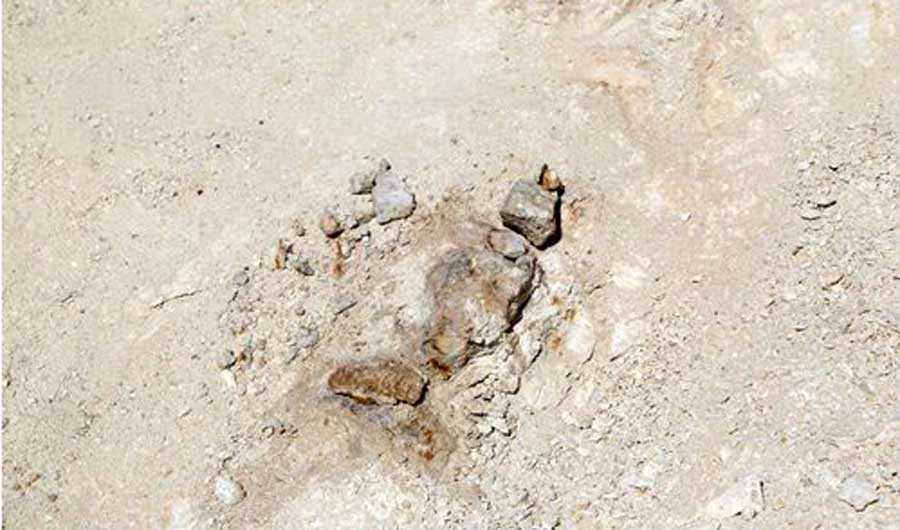
Fossilized archaeocete bone embedded in calcareous chalk and marl matrix, Al-Rashrashiyah Formation
Archaeocete remains in calcareous bituminous chalk and marl—the first nearly complete Eocene whale skeleton from the Kingdom.Supplied / Arab News · Arab News

Arab News · 6 July 2021

New discovery shines light on Saudi Arabia's ancient marine environment

Al-Rashrashiyah Formation · Priabonian · Upper Eocene

Announced 29 June 2021, the Saudi Geological Survey unveiled a graveyard of fossilized whale bones in the Al-Jouf region—a rare Priabonian archaeocete and the only nearly complete Eocene whale skeleton found in the Kingdom. Iyad Zalmout, SGS paleontology technical adviser, helped lead the discovery.

Age
~37 Ma
Length
~3 m
Weight
500600 kg
Site
Near Qurayyat, northwestern Saudi Arabia
  • Complete articulated vertebral column
  • Articulated forelimbs and shoulder blades
  • Ribs, skull, and lower jaw fragments
  • Graveyard of fossilized whale bones

This new whale is similar in size and morphology to the partial skeleton found in the western desert of Egypt… However, the new material from Saudi Arabia is more complete and will add more information to this group of whales.

Iyad S. Zalmout, Arab News
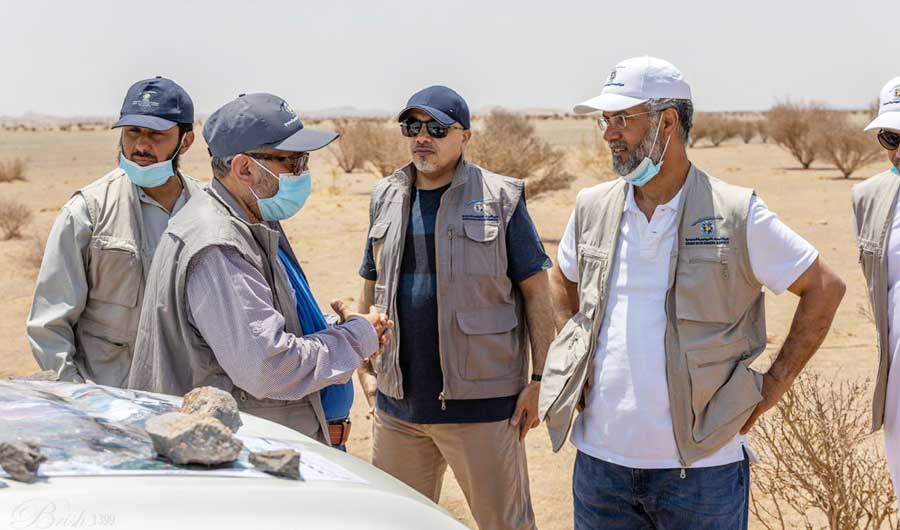
Al-Rashrashiyah cliffs near Qurayyat, northwestern Saudi Arabia — site of the 2021 Eocene whale graveyard
The SGS paleontology team in the field—local and international geologists and paleontologists who uncovered the Al-Rashrashiyah whale graveyard in northwestern Saudi Arabia.Supplied / Arab News

Chalk to Ocean

Drag across the Rashrashiyah fossil matrix to reveal the Eocene marine world these archaeocetes inhabited.

Ancient whale swimming in open ocean representing Eocene marine environments of Arabia

Supplied / Arab News

Fossilized archaeocete bone embedded in calcareous chalk and marl matrix, Al-Rashrashiyah Formation

Al-Rashrashiyah Formation

Desert StrataTethys Ocean

In plain termsEocene shark teeth and marine fossils from the Khurais oil field region.

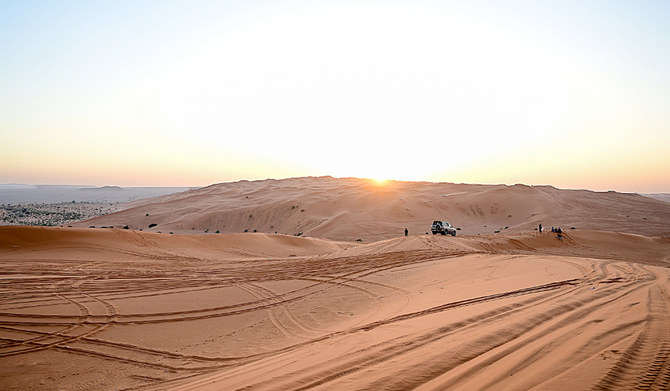
Khurais desert dunes at sunset with field vehicle and researchers on the Shark Teeth Trail

Arab News · 28 February 2023

Shark Teeth Trail

Dammam Formation · Middle Eocene · Lutetian · Khurais desert, eastern Saudi Arabia

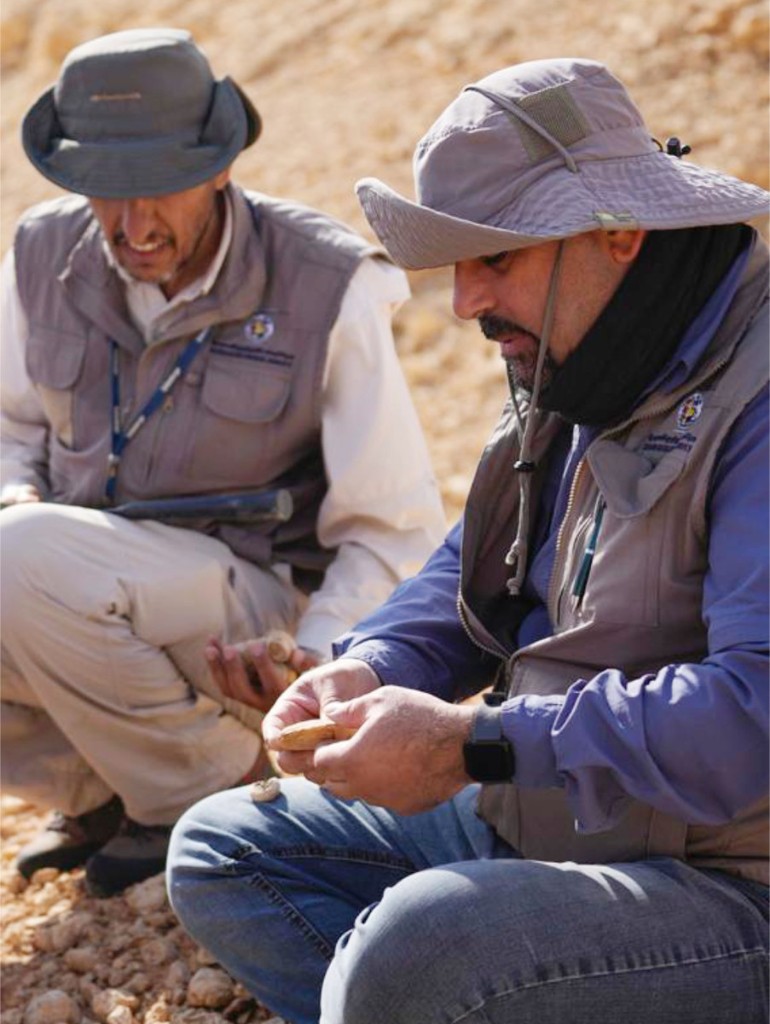
Iyad Zalmout and SGS colleague examining fossils at the Dammam Formation outcrop in Khurais

Carbonate rocks, shales, and marl of the Dammam Formation preserve a shallow marine ecosystem from when the eastern Arabian Peninsula lay beneath the Tethys Sea—46 million years before today's Khurais desert. In a deep-dive interview with Arab News, Iyad Zalmout—technical adviser at the SGS Geology and Paleontology Survey and Exploration Center—described how surface fossils assemble a portrait of Tethyan marine ecology from ~46 million years ago.

We may be able to assemble an image of the depositional environment and marine ecology of the Tethyan Sea in Saudi Arabia 45 million years ago.

Iyad S. Zalmout, SGS Paleontology technical adviser
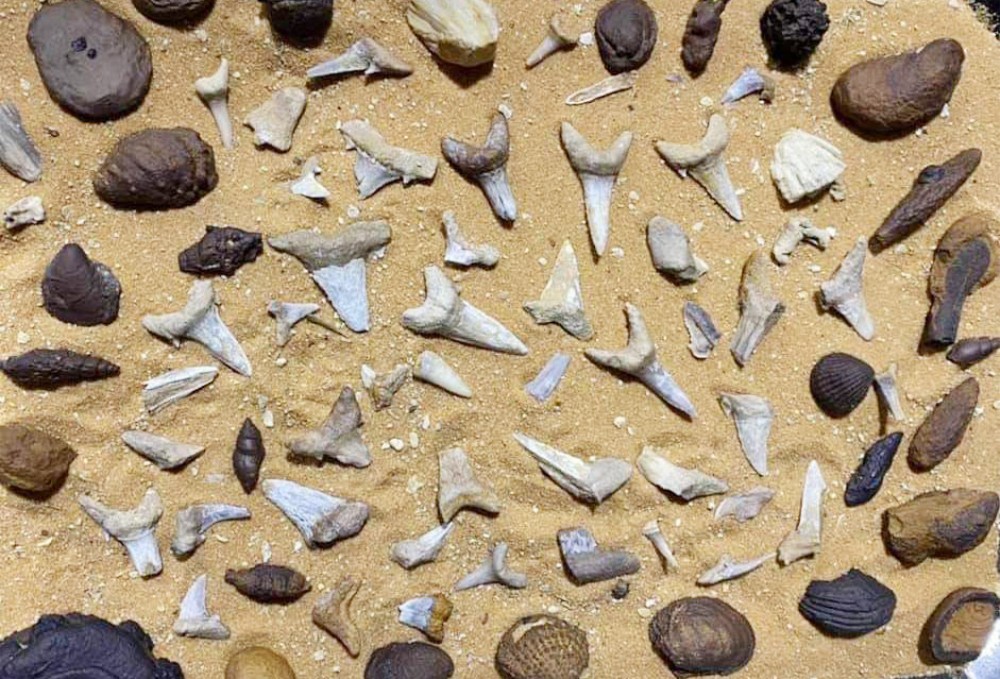
  • Shark teeth abundant: Isurus, Cretolamna, Odontaspis, Galeocerdo, Carcharhinus
  • Ray fossils: sawfish, eagle rays, and knifetooth species
  • Bony fishes: extinct barracuda, saber-toothed herring, billfish, butterflyfish-like species
  • Molluscs, bivalves, solitary corals on shale beds
  • SGS developing Khurais as a natural paleontological reserve

Desert to Tethys

Drag across the carbonate outcrop to reveal the shark teeth, rays, and shells of a shallow Eocene sea.

Collection of fossilized shark teeth, shells, and marine remains from the Dammam Formation on desert sand

Saudi Geological Survey

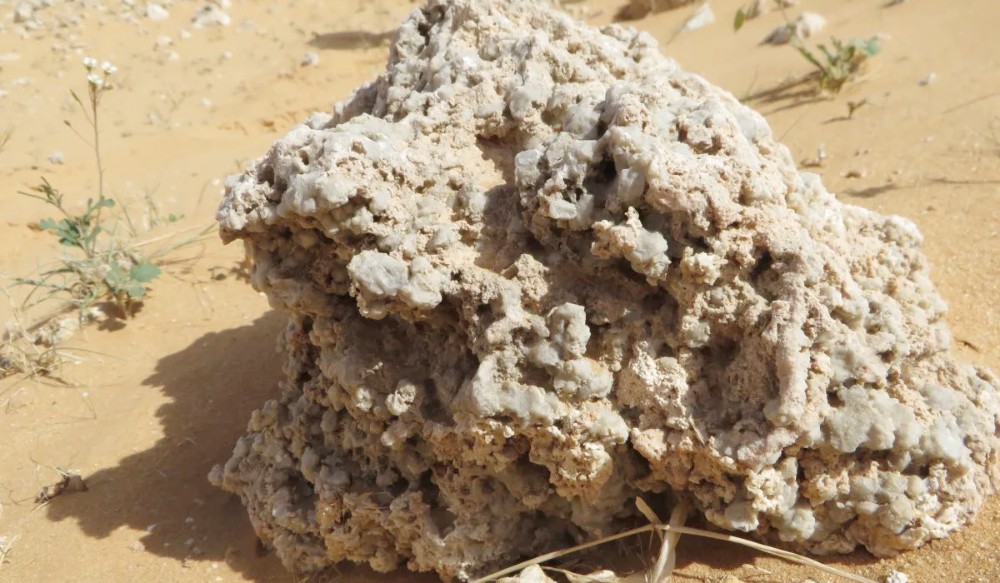
Porous carbonate rock from the Dammam Formation resting on desert sand

Saudi Geological Survey

Desert StrataTethys Ocean
Large fossilized lamniform shark tooth from the Dammam Formation with serrated crown
Long-bladed lamniform dentition resembling mako and sand tiger sharks—apex predators of the Lutetian Tethys.Saudi Geological Survey
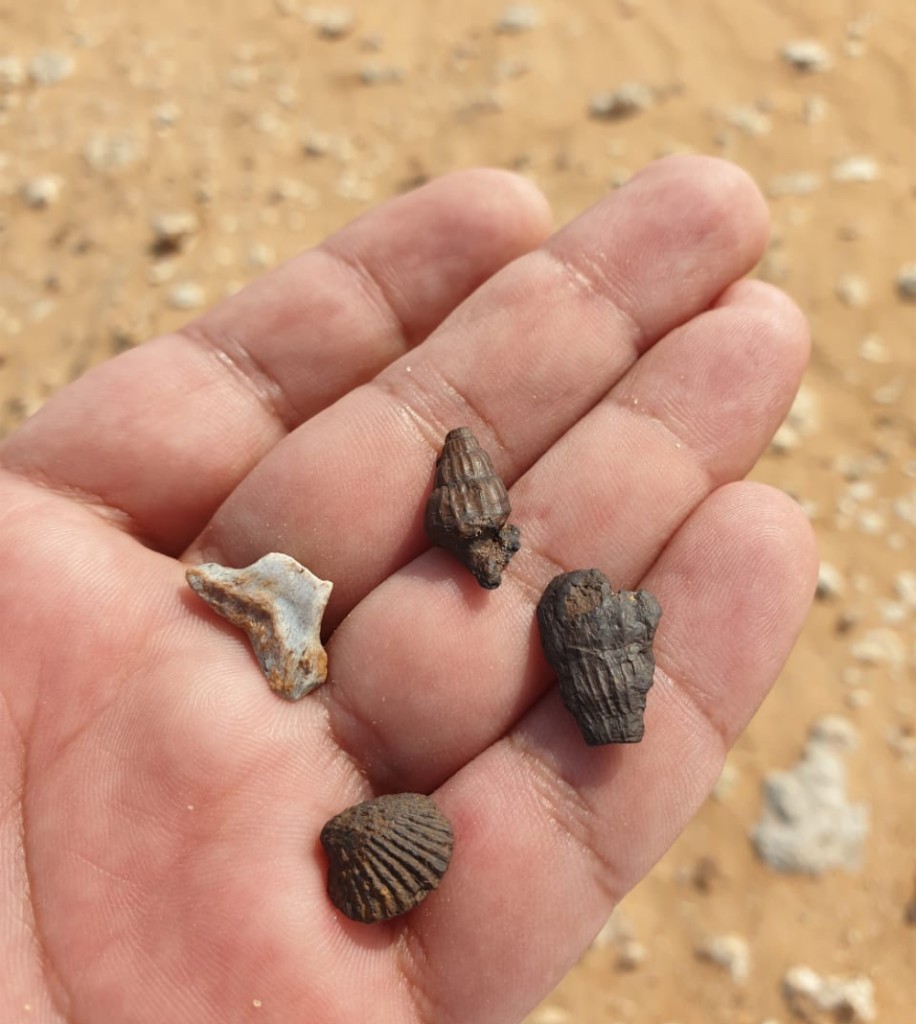
Fossilized gastropod, bivalve, and bone fragments held in a researcher's palm at Khurais
Snails, bivalves, and bone fragments recovered in situ—evidence of a shallow marine food web 45 million years ago.
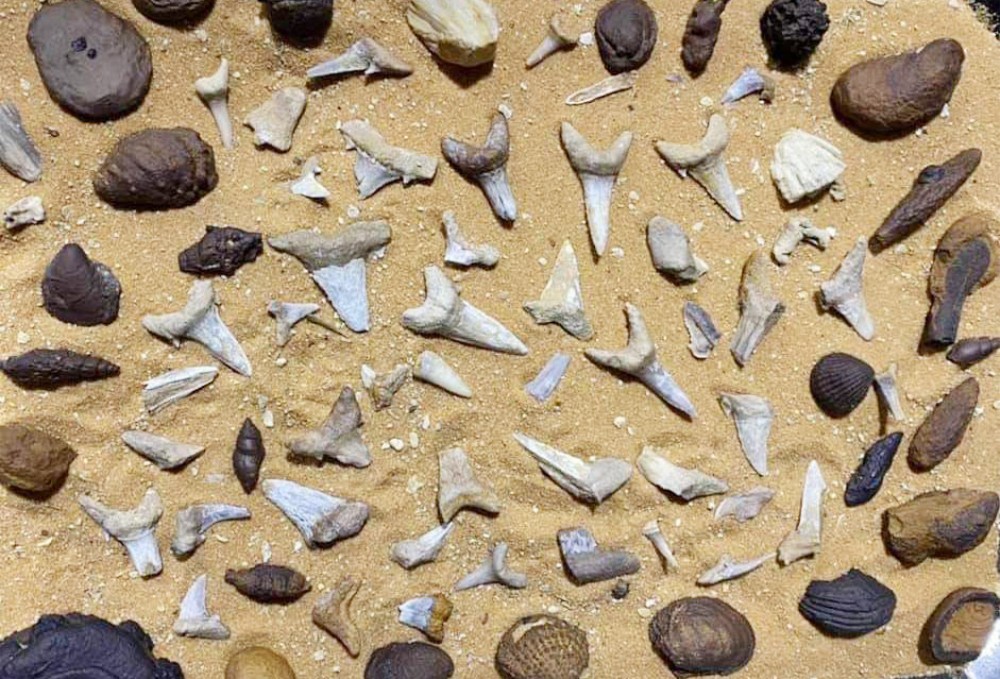
Diverse Middle Eocene marine fossils including shark teeth and mollusk shells arranged on sand
Field cataloging of chondrichthyan dentitions, bony fish fragments, and invertebrates from the Shark Teeth Trail.

Only one scientific note was published on the fauna and flora of the Eocene Dammam Formation from Khurais back in the 70s of the last century. We are hoping that more can be done in terms of research and conservation on the site.

Formation exposed across Khurais, Dammam, Al Khobar, Eastern Empty Quarter subsurface—and beneath aeolian sands of the Empty Quarter. Khurais lies near a major oil field, but these Eocene fossils record a separate chapter of marine deposition, not Jurassic petroleum maturation.

In plain termsExtinct straight-tusked elephant from the Saudi Nafud Desert.

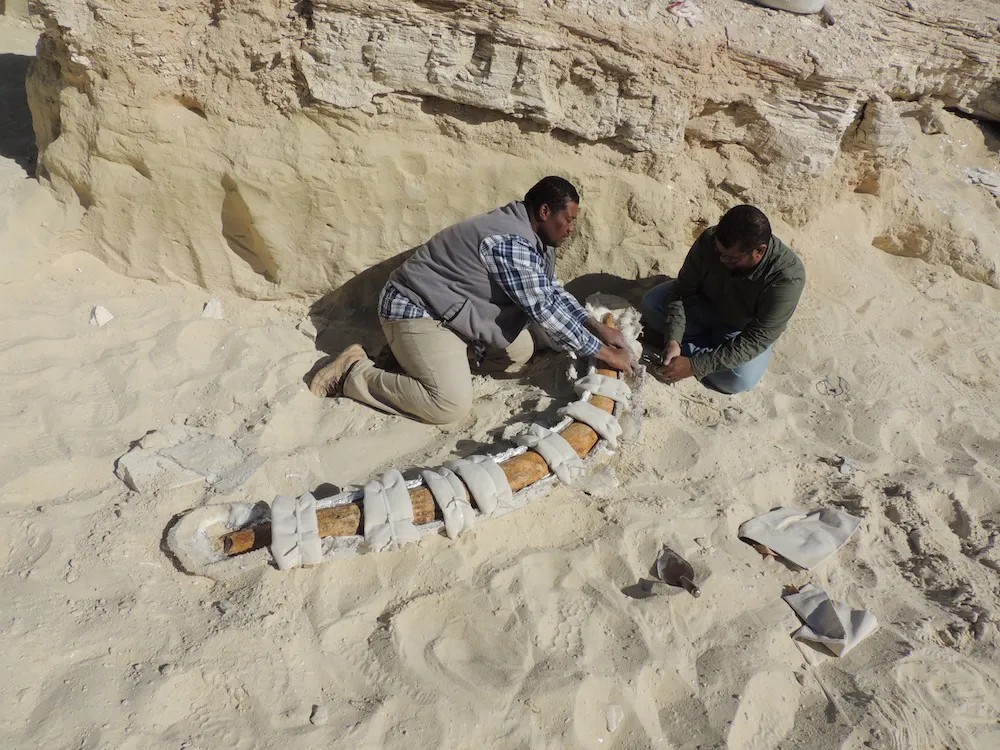
SGS researchers jacketing a 500,000-year-old Elephas recki tusk in the Nafud Desert, Saudi Arabia

Live Science · 30 August 2017

Ancient 'Monster' Elephant Was 50 Percent Bigger Than Modern Cousins

Elephas recki · ~500k ya · Middle Pleistocene

Half a million years ago, the Arabian Peninsula was a lush, lake-dotted landscape—not today's sandy desert. Iyad Zalmout, paleontologist with the Saudi Geological Survey, led excavation of a gigantic elephant bull whose bones rank among the best-preserved E. recki specimens from the Middle East, presented at Society of Vertebrate Paleontology (23 August 2017).

  • ~60% of skeleton preserved—among the best from the Middle East
  • 50% larger than today's biggest elephants; at least twice the weight
  • Adult bull preserved in ancient lake sediments of a wet Arabian Peninsula
  • Laser-scanning digitizer creating 3D models for virtual sharing
  • Camels, gazelles, big cats, and hyena ancestors shared the landscape

It was a vibrant place.

Iyad S. Zalmout, on Pleistocene Arabia

Jacketing the tusk of a half-million-year-old Elephas recki bull—50% larger than modern elephants—from lake sediments in a Pleistocene Arabian Peninsula that was lush and wet, not desert.

This work is providing a more detailed understanding of the bones of this species of elephant. This is important because it provides the foundation for more-thorough analyses of new sites where we anticipate more remains of this type of elephant will occur.

Dan Fisher, University of Michigan Museum of Paleontology
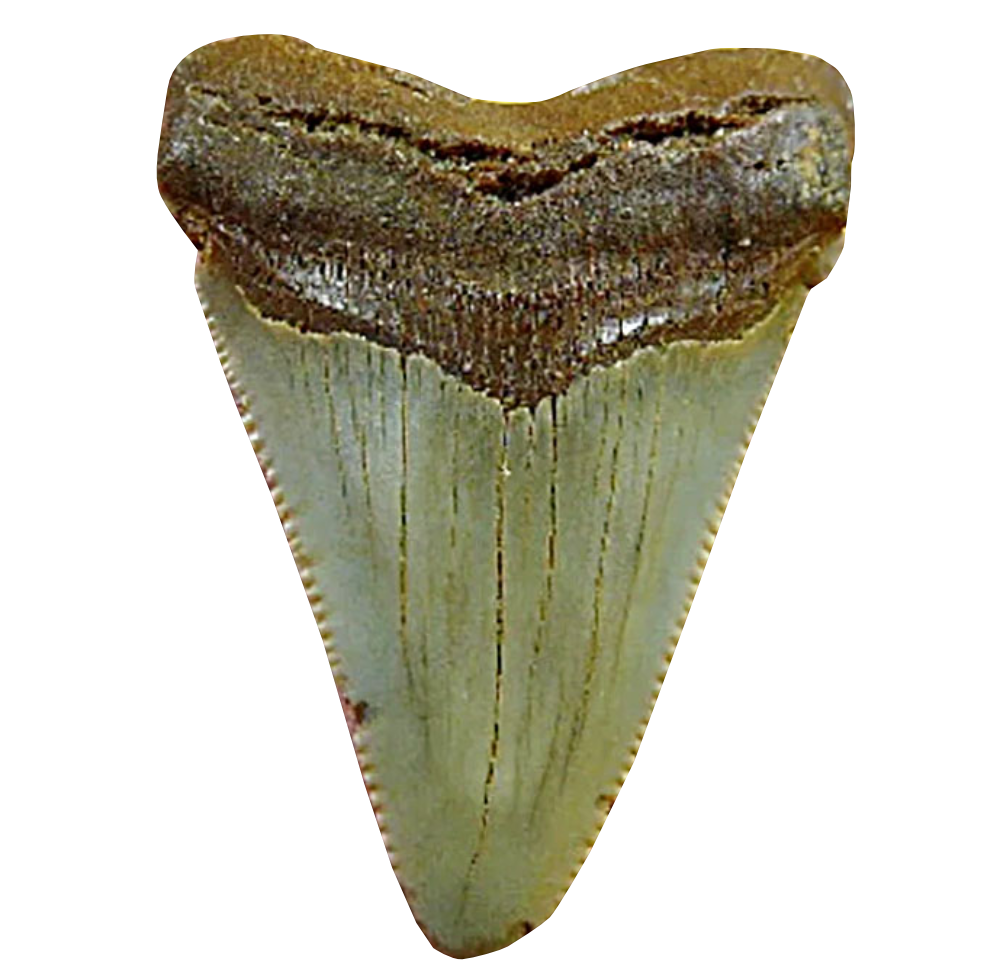
Photo: Saudi Geological Survey · 2014–2017 · Nafud Desert, northwestern Saudi Arabia

In plain termsAn 85,000-year-old human finger bone — among the oldest Homo sapiens outside Africa.

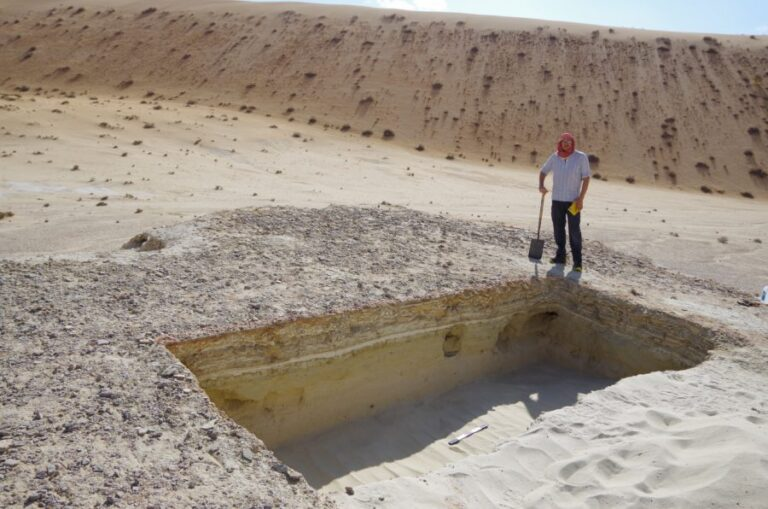
Archaeological excavation at Al Wusta in Saudi Arabia's Nefud desert where a Homo sapiens finger bone was found in 2016

SAPIENS · Wenner-Gren Foundation · 16 April 2020

Will Asia Rewrite Human History?

Al Wusta 1 — middle phalanx (finger bone) · ~87.6k ya · Al Wusta, Nefud Desert, Saudi Arabia

Walking through the Al-Wusta dig site in 2016, SGS paleontologist Iyad Zalmout spotted a tiny bone eroding from sediment. The 87,000-year-old intermediate phalanx—probably a middle finger—became the earliest directly dated Homo sapiens fossil outside Africa and the Levant, evidence that humans spread farther and faster than once thought.

  • Earliest directly dated Homo sapiens fossil outside Africa and the Levant
  • Uranium-series age 85.1–90.1 ka (~87,600 ± 2,500 years)
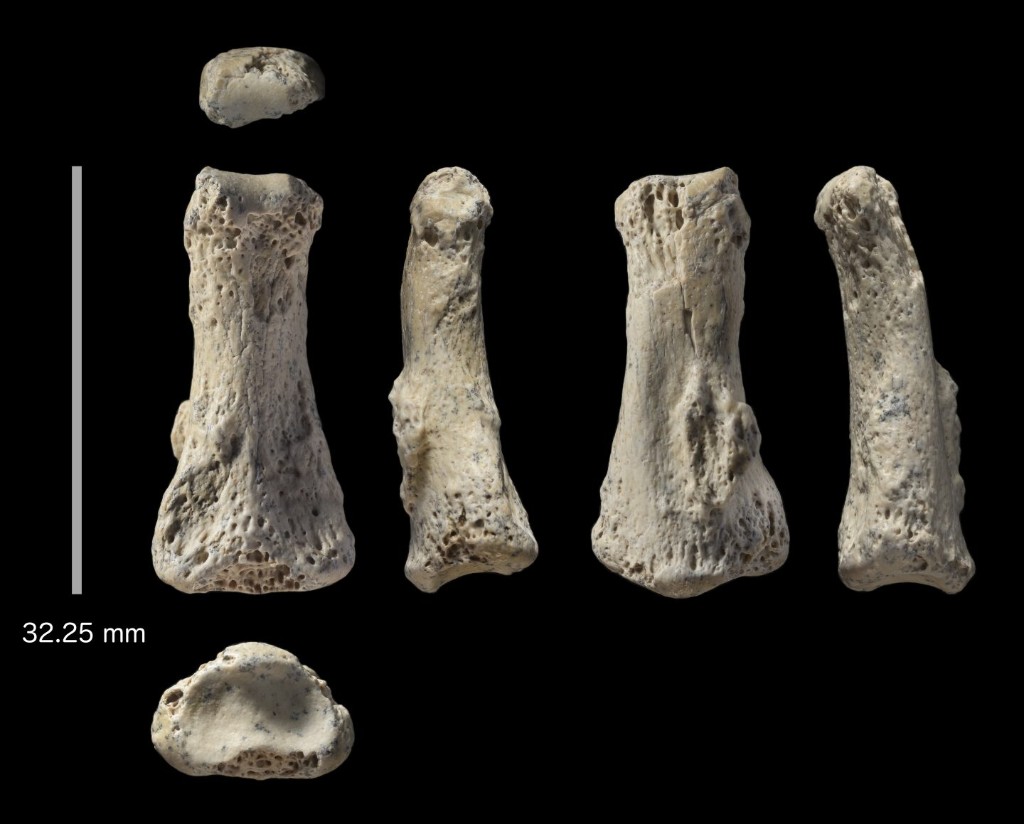
  • Intermediate phalanx 32.3 mm long—slender, unlike Neanderthal digits
  • Enthesophyte records repeated physical stress on hands
  • 380 stone tools and 800+ animal fossils at a Pleistocene lake shore
  • Wet grassland with hippos and African antelope—not today's desert
  • Evidence humans spread farther and faster than previously thought

We knew it [was] important. It was the first direct evidence of any large primate or hominid life in the area.

Iyad S. Zalmout
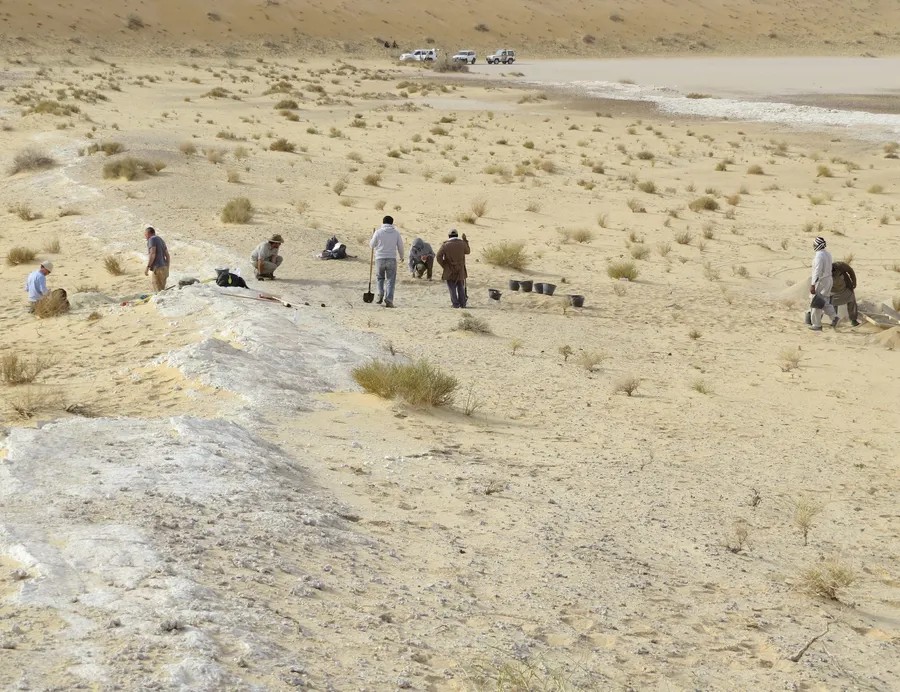
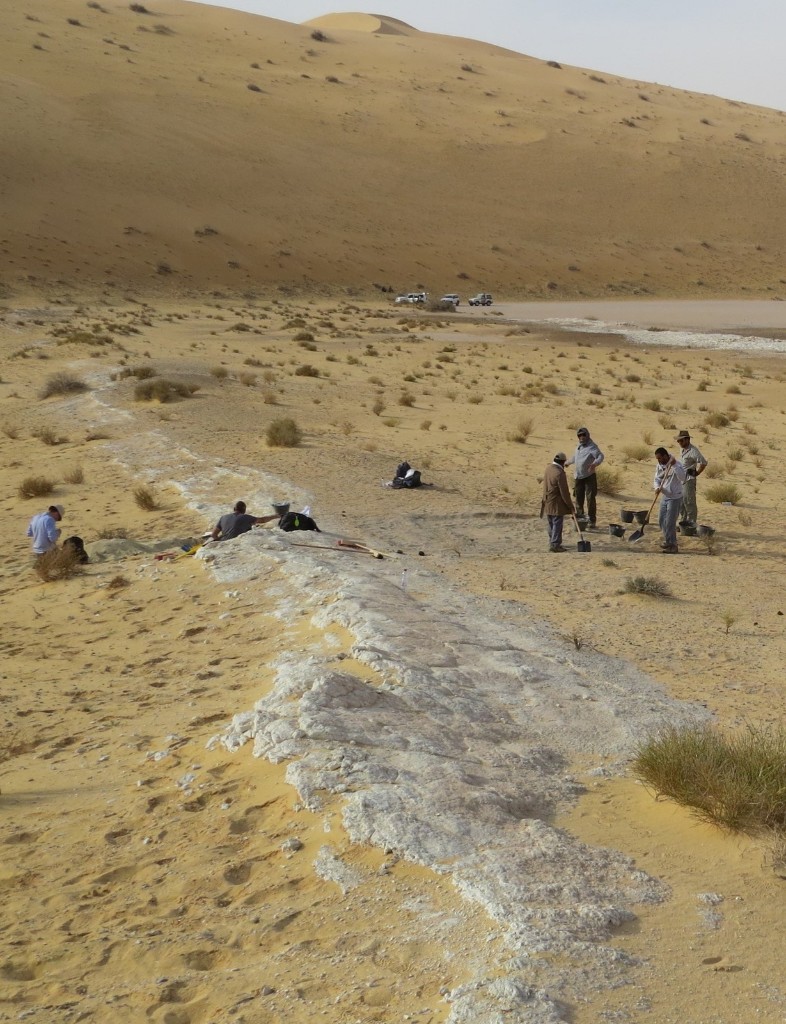
Archaeological team excavating along the white ancient lake bed at Al Wusta in the Nefud Desert

Ars Technica · 9 April 2018

History gives us the finger

Saudi Arabian fossil find puts finger on the story of human dispersal

Around 84,000 years ago, stronger monsoons transformed Arabia into a grassland dotted with lakes. Al-Wusta was a shallow shore where hippos wallowed, African antelope grazed, and hunter-gatherer bands left 380 stone tools among 800+ animal fossils—the first site in the region with human remains.

So actually it does all fit together very neatly, with Al-Wusta being an early representative of a much broader process.

Huw Groucutt
Aerial view of Al Wusta excavations with white ancient lakebed surrounded by Nefud sand dunes

Haaretz · Archaeology · 9 April 2018

85,000-year-old Homo Sapiens Bone Found in Saudi Arabia Rewrites Human History

By Ruth Schuster

A single finger bone found in 2016 by Iyad S. Zalmout, paleontologist with the Saudi Geological Survey, has been definitively identified as Homo sapiens—changing the paradigm of migration out of Africa. Far from the sea, deep in today's Nefud desert, the find rejects the model of humans hugging coastlines while leaving Africa.

The Al Wusta fossil proves modern humans reached Arabia by 90,000 years ago.

Michael Petraglia

We view the 60,000-year-old exodus as one of many migrations out of Africa—hence the Arabian fossil supports a multiple migrations model out of Africa.

Michael Petraglia

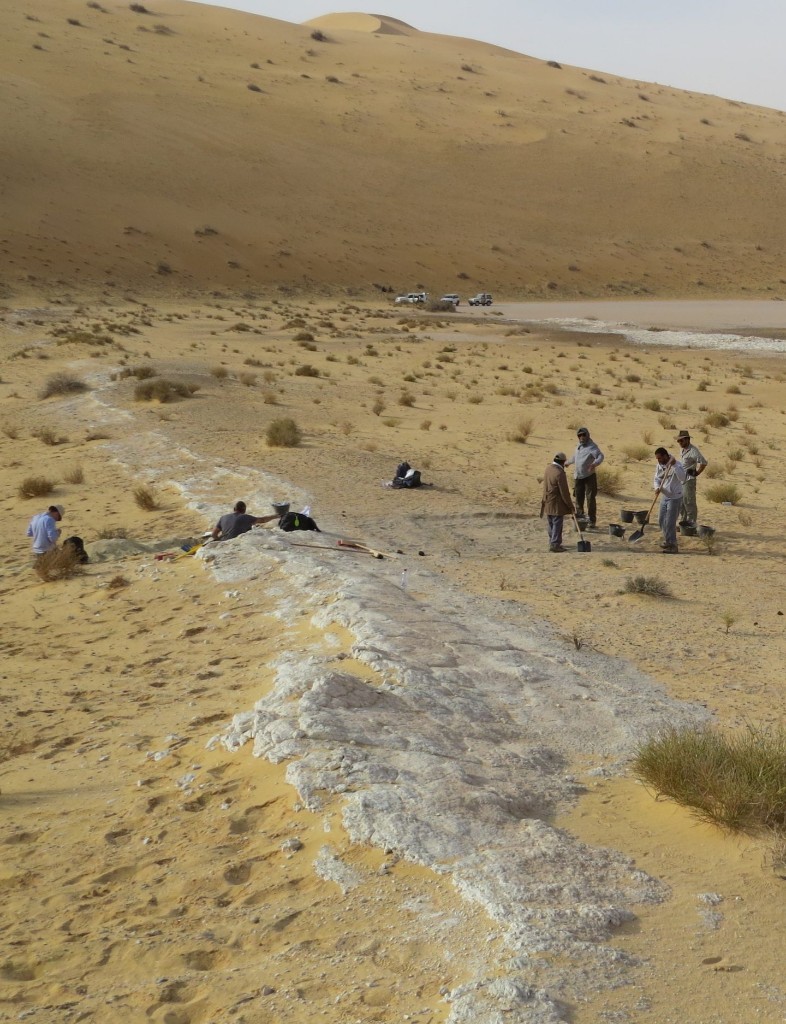
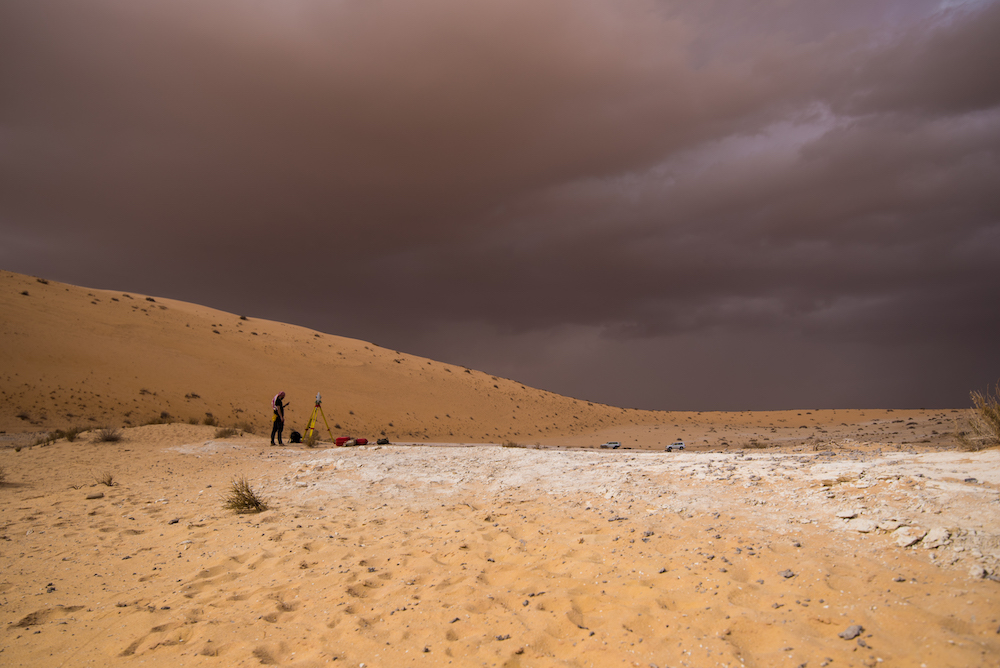
General view of excavations at Al Wusta—the white ancient lakebed where hippos once lived, now ringed by sand dunes of the Nefud Desert.

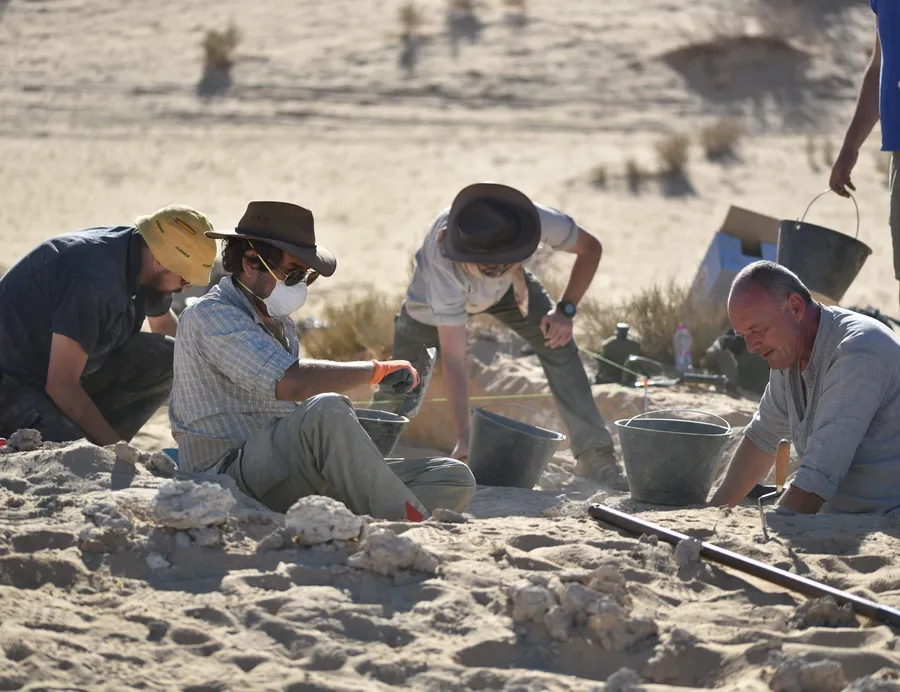
Archaeologists excavating in a gridded trench at Al Wusta in the Nefud Desert, Saudi Arabia

When hippos frolicked in Arabia

Excavating at Al Wusta—today in the heart of the al-Nefud desert, but during the Pleistocene a semi-arid grassland with freshwater lakes and hippos. The team recovered 380 stone tools and 800+ animal fossils—including hippos—confirming a wet grassland, not today's forbidding desert.

Thanks to satellite images, we now know there was a network of rivers in Arabia, and we have counted up to 10,000 ancient lakes.

Michael Petraglia

Very detailed morphological and scientific comparative analysis has shown that the finger bone falls nicely within the range of variation of Homo sapiens, and outside the Neanderthal range. Thus, we assign it to Homo sapiens.

Michael Petraglia · Our dates are therefore very secure.
Image: Klint Janulis · Al Wusta, Nefud Desert, Saudi Arabia
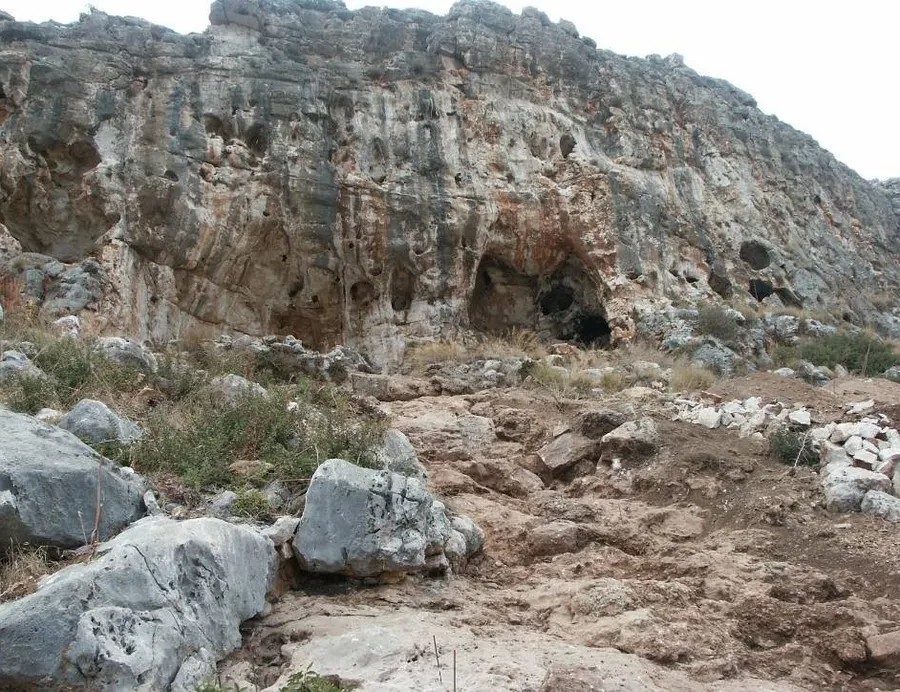
Misliya Cave on Mount Carmel, Israel—earliest known Homo sapiens remains outside Africa at ~200,000 years
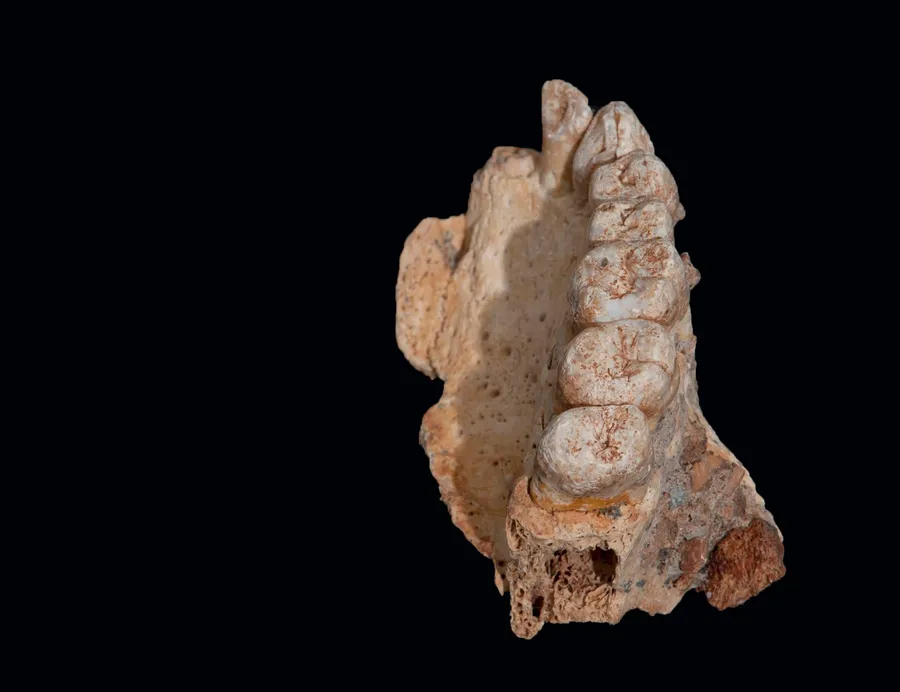
Maxilla of Misliya-1 hominin identified as early Homo sapiens, ~200,000 years old

Out of Africa · Misliya and Al Wusta

Misliya Cave, Mount Carmel—jawbone evidence that Homo sapiens began migrating out of Africa around 190,000 years ago, predating the Al Wusta finger by more than 100 millennia. Misliya-1 maxilla—upper jaw of early Homo sapiens used in comparative morphological analysis alongside the Al Wusta intermediate phalanx. Comparative analysis drew on primate, Neanderthal, and human samples—including remains from Israel, Egypt, Canterbury, and Dorset—to assign the Al Wusta phalanx to Homo sapiens.

The million dollar question is what happened to these people once these bountiful environments dried up. Did they go extinct? Did they move on to more hospitable environments? We are still searching for the answers to these questions.

Michael Petraglia
Misliya cave: Mina Weinstein Evron / University of Haifa · Maxilla: Israel Hershkovitz / Tel Aviv University

Desert to Discovery

Drag from the excavation to the holotype finger bone—Al Wusta 1.

Multiple photographic views of the Al Wusta Homo sapiens intermediate phalanx on black background with 32.25 mm scale

Ian Cartwright / Palaeodeserts Project

Archaeological team excavating along the white ancient lake bed at Al Wusta in the Nefud Desert

Michael Petraglia / Palaeodeserts Project

Desert StrataTethys Ocean
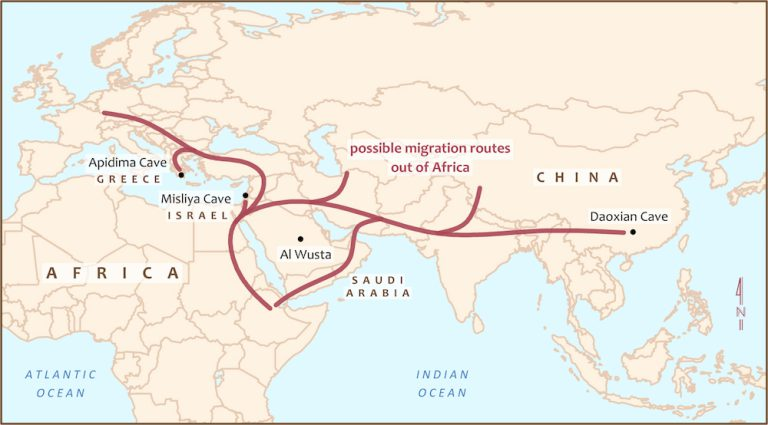
Map showing possible early Homo sapiens migration routes out of Africa including Al Wusta in Saudi Arabia
Multiple dispersal routes out of Africa—Al Wusta anchors the southern Arabian corridor alongside Misliya, Apidima, and Daoxian.

A new story is unfolding.

Michael Petraglia
Catherine Gilman / SAPIENS
Multiple photographic views of the Al Wusta Homo sapiens intermediate phalanx on black background with 32.25 mm scale
Al Wusta 1 photographed from six angles—long, slender proportions distinguish modern human digits from Neanderthals and apes.32.3 mm · 8.5 mm mid-shaft
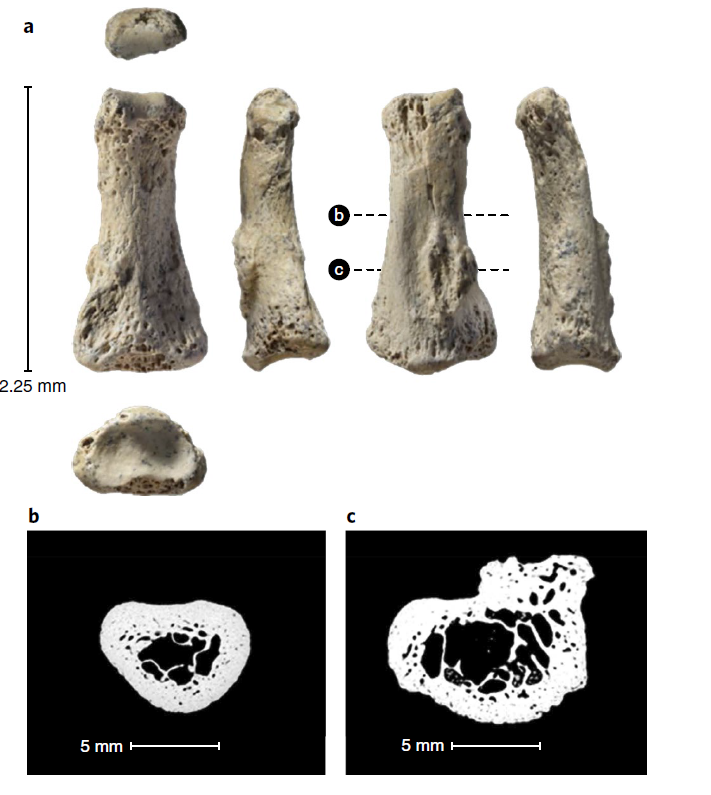
Al Wusta finger bone photographs and CT cross-sections showing enthesophyte marked C
CT scans reveal an enthesophyte (C)—a bony growth from repeated ligament stress, possibly from stone-tool manufacture.

We can speculate that it could be something from even, like, making stone tools from the site, although there's no way to be sure.

Michael Petraglia
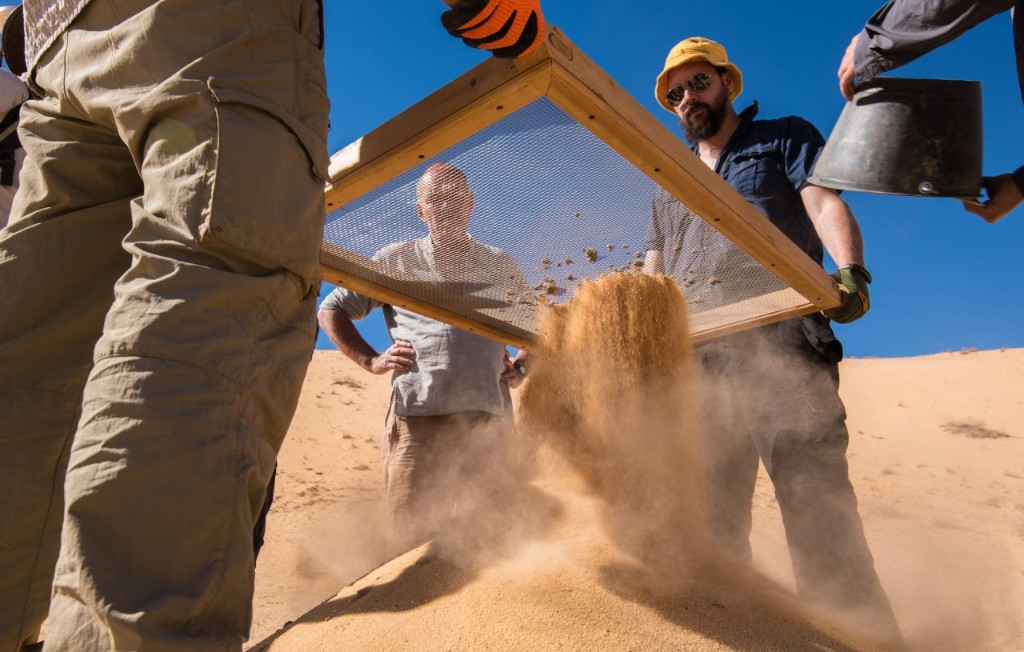
Archaeologists sieving sand at the Al Wusta site in the Nefud Desert
Sieving ancient lakebed sediments at Al Wusta—searching for stone tools, fossils, and traces of a once-verdant Arabian landscape.Klint Janulis / SAPIENS
Archaeologists surveying the Al Wusta dig site in the Nefud Desert under dramatic skies
Surveying the Al Wusta lakebed—where monsoon rains once transformed the Nefud into grasslands with freshwater lakes.Klint Janulis / SAPIENS
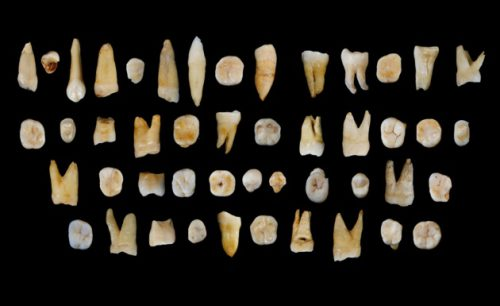
Fossil teeth from Pleistocene fauna recovered near Al Wusta
Faunal remains from the ancient lake system—hippopotamuses, antelope, and wild cattle that confirm a wet, grassland Arabia.Al Wusta field team

Al Wusta 1 — anatomically modern human middle phalanx (~32 mm), uranium-series dated to at least 86,000 years ago.

He picked up the bone and he immediately recognized it as human. It was that distinctive.

Michael Petraglia, on Iyad S. Zalmout

These animals tell us that when humans were living there, it was not a desert. There were abundant animals and a lot of people living there.

Huw Groucutt

Article by Sara Toth Stub. Images include human remains.

In plain termsAncient lakes in the Nefud Desert that drew early humans and wildlife.

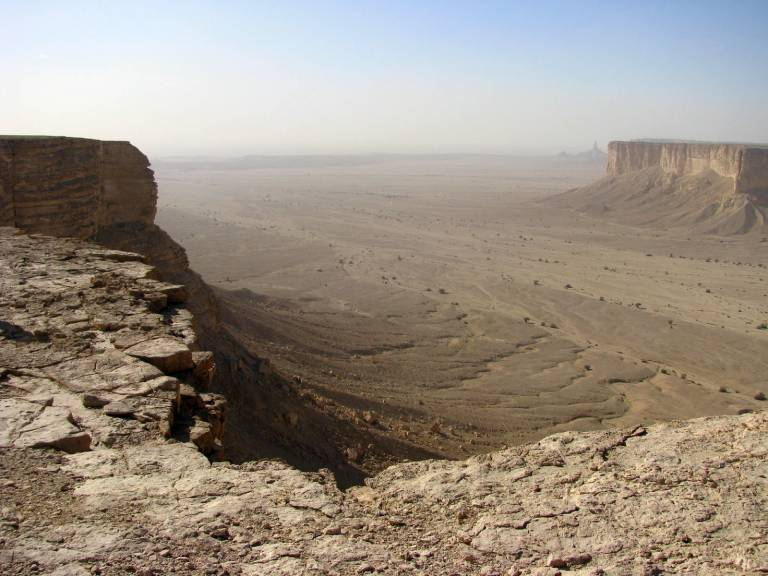
Layered escarpments and arid valley floor of the western Nefud Desert on the Nejd Plateau

Human Evolution @ UCL · 9 March 2017

Wet Seasons in the Nefud Desert featured many wetlands during the Pleistocene allowing hominin occupation

Western Nefud Desert · Nejd Plateau · Pleistocene–Holocene

Archaeologists surveying the Al Wusta dig site in the Nefud Desert under dramatic skies

Interdisciplinary surveys of palaeolake deposits in the western Nefud identified thousands of wetlands and 46 prehistoric archaeological sites—from Lower Palaeolithic to pre-Islamic Holocene—showing how episodic wet periods enabled human dispersal across Arabia's desert belt. Iyad S. Zalmout co-authored the interdisciplinary study with Huw S. Groucutt, Michael D. Petraglia, and Saudi colleagues—linking satellite-identified palaeolake deposits to archaeological and palaeontological assemblages across the desert belt.

  • Thousands of discrete palaeolakes and palaeowetlands mapped via satellite imagery
  • 46 prehistoric sites linked to freshwater deposits
  • Lower Palaeolithic sites concentrated near raw material at the Nefud fringe
  • Middle Palaeolithic occupations extend deeper into the dune field
  • First Neolithic hearth complexes documented deep within the dunes
  • Western Nefud may have offered more reliable water than elsewhere in northern Arabia

The survey contextualizes later discoveries such as the Al Wusta Homo sapiens finger bone—evidence that wet Pleistocene grasslands and lakes once transformed landscapes now dominated by sand.

The western Nefud—today an arid dune field, but episodically wetter in the past when palaeolakes and marshes filled thousands of depressions across the Nejd Plateau.

Western Nefud Desert, Saudi Arabia · Nefud interdisciplinary survey team

In plain termsGreen Arabia — when the peninsula was wetter and humans dispersed across it.

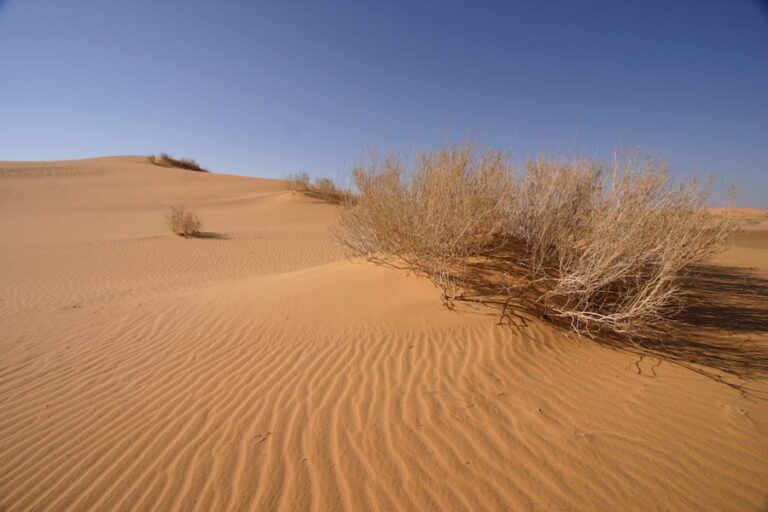
Red sand dunes and sparse desert vegetation in the Great Nefud Desert

Popular Archaeology · 5 August 2024

Lost Worlds of Arabia

Thousands of years of pre-Islamic human habitation in the Great Nefud

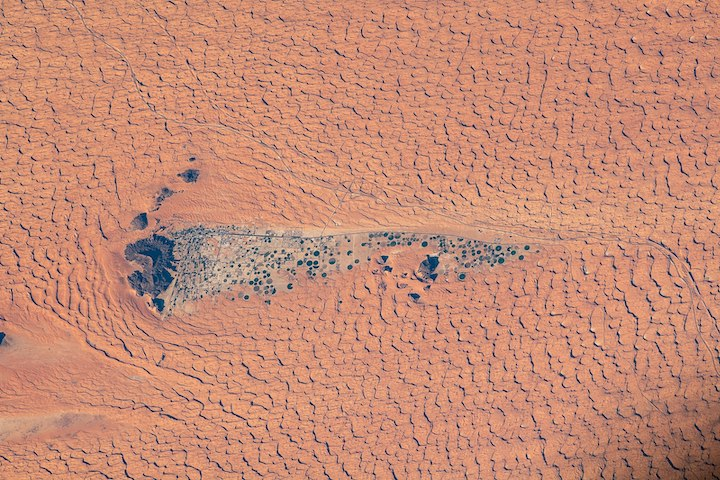
Satellite view of Jubbah city surrounded by Nefud sand dunes with center-pivot fields

Following the water

Lacustrine deposits across the Nefud preserve evidence of Green Arabia—episodic wet intervals when lakes, wetlands, and savanna-like ecosystems enabled hominin dispersal long before today's hyper-arid desert. Teams have surveyed lacustrine deposits across Great Nefud Desert · ~70,000 km² northern Saudi Arabia—depressions that once held lakes, wetlands, and African-like savannas during Green Arabia wet phases.

  • Ancient palaeolakes visible as distinct lacustrine deposits amid red dunes
  • Ti's al Ghadah: first dated middle Pleistocene fauna in Arabia
  • Al Wusta 2016: only direct human fossil in region at ~90 ka
  • Centripetal Levallois technology at Al Wusta—Middle Paleolithic
  • Arabian Peninsula as corridor for repeated out-of-Africa dispersals
Archaeological trench at Ti's al Ghadah palaeolake site in the Nefud Desert

Ti's al Ghadah, southwestern Nefud

Ti's al Ghadah—630 m Pleistocene palaeolake outcrop with stone tools and butchered fauna dated 500–300 ka, the first hominin-associated assemblage from Arabia.

This makes Ti's al Ghadah the first, early hominin-associated fossil assemblage from the Arabian Peninsula, demonstrating that our ancestors were exploiting a variety of animals as they wandered into the green interior.

— Michael D. Petraglia
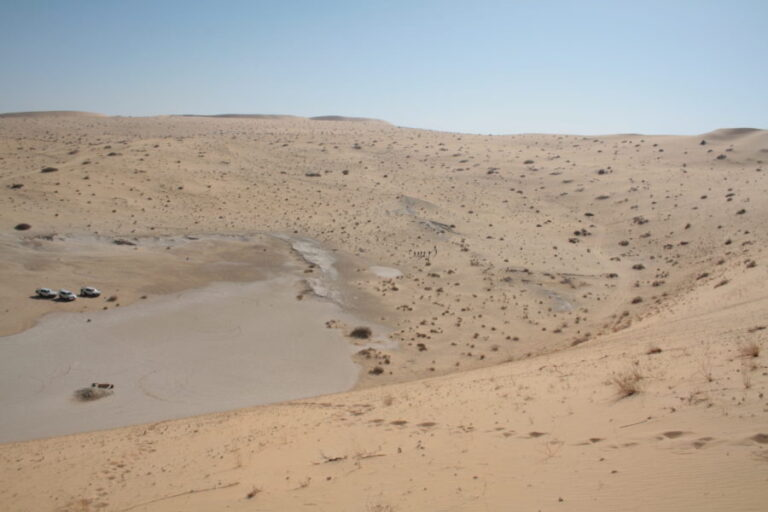
Al Wusta palaeolake basin viewed from atop a neighboring sand dune with field vehicles

Al Wusta · 2016

Al Wusta from a neighboring dune—the inter-dunal depression where lake sediments, stone tools, and the Al Wusta 1 finger bone were found in 2016.

Then our colleague, Dr Iyad Zalmout from the Saudi Geological Survey, picked up a small and well preserved fossil.

Huw S. Groucutt
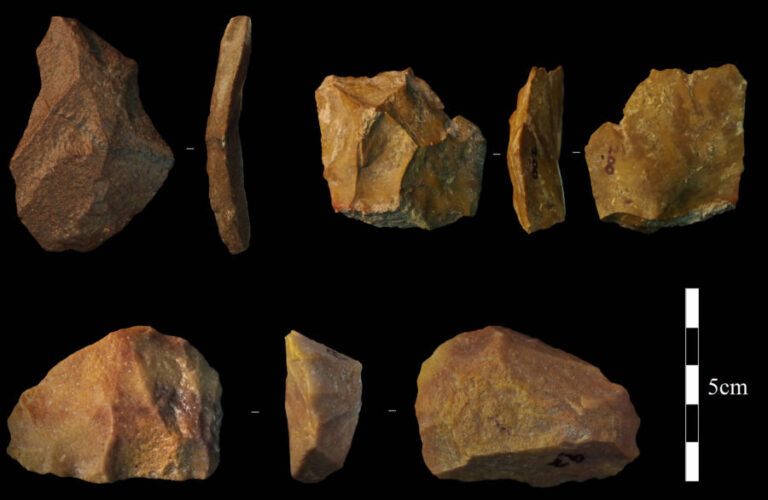
Levallois flakes and core stone tools from Al Wusta on black background
Centripetal Levallois technology at Al Wusta—Middle Paleolithic flakes and core associated with early modern humans.
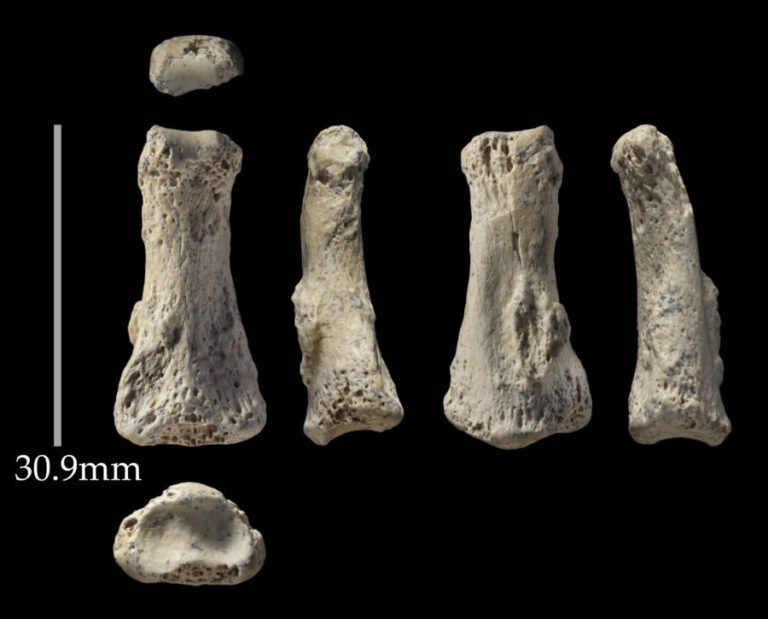
Al Wusta 1 Homo sapiens intermediate phalanx photographed from multiple angles with 30.9 mm scale
Al-Wusta 1—gracile intermediate phalanx (30.9 mm) aligning with Homo sapiens rather than robust Neanderthal digits.

The values for the Al Wusta finger bone clearly aligns it with Homo sapiens.

Huw S. Groucutt

It's remarkable; every time it was wet, people were there. This work puts Arabia on the global map for human prehistory.

— Michael D. Petraglia

Arabia has long been seen as empty throughout the past. Our work shows that we still know so little about human evolution in vast areas of the world and highlights the fact that many surprises are still out there.

Huw S. Groucutt
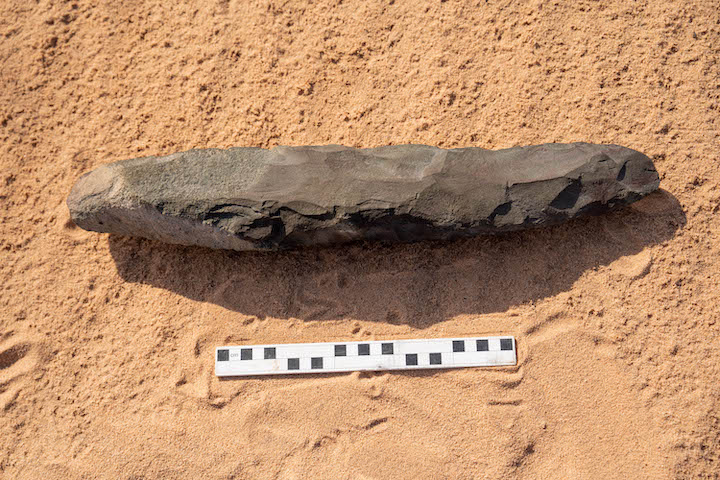
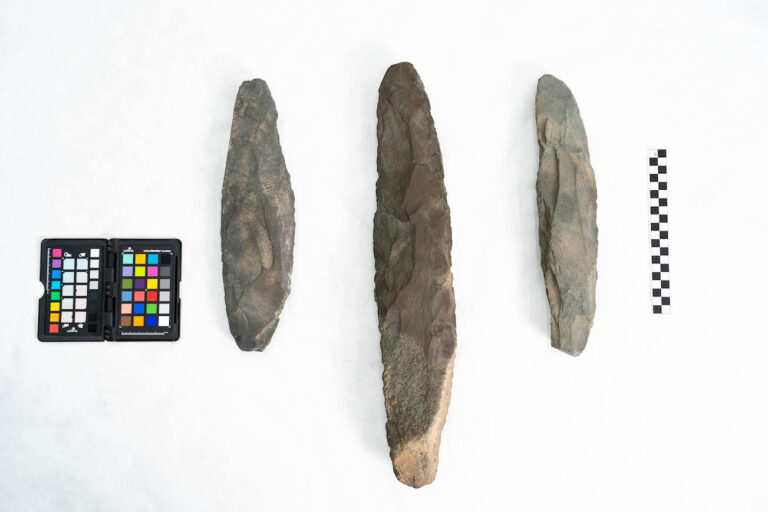
Large Acheulean hand axe from AlUla region on desert sand with scale bar
Giant stone hand axes from AlUla—preliminary assessment >200 ka, Lower–Middle Palaeolithic precursors to later Nefud occupations.
Three Acheulean hand axe artifacts from AlUla with color checker and scale
Acheulean bifaces from RCU/TEOS Heritage surveys—evidence of deep hominin presence across the Arabian Peninsula.

In plain termsNeolithic and Bronze Age remains preserved in a Saudi lava-tube cave.

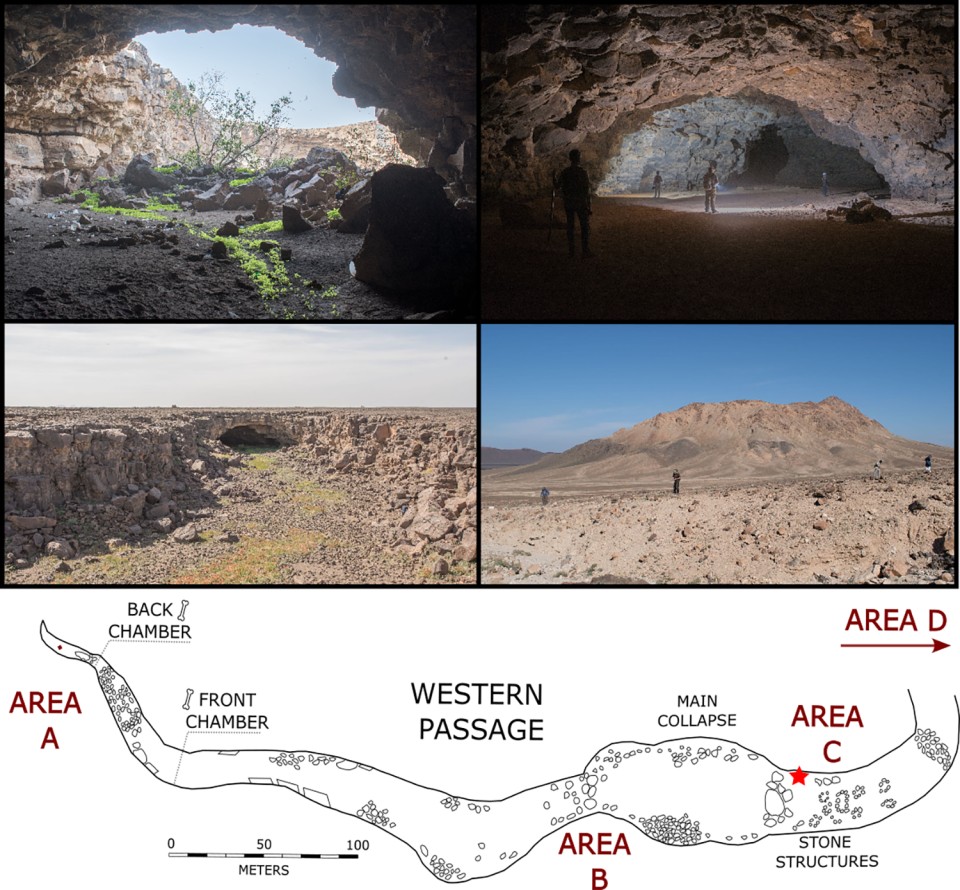
Photographs and plan of Umm Jirsan lava tube cave system in Harrat Khaybar, Saudi Arabia

Griffith University · PLOS ONE · 17 April 2024

First evidence of human occupation in lava tube cave in Saudi Arabia

Umm Jirsan · Neolithic · Chalcolithic · Bronze Age · ~10,000–3,500 years ago

In Harrat Khaybar's volcanic landscape, interdisciplinary excavations revealed the first evidence of human occupation in an Arabian lava tube. Iyad Zalmout co-authored the PLOS ONE study with Griffith University's ARCHE team, SGS colleagues, and international partners—uncovering pastoral routes, rock art, and isotopic records spanning millennia.

  • First comprehensive lava-tube archaeology study in Saudi Arabia
  • Repeated occupation from Neolithic through Chalcolithic/Bronze Age
  • Pastoral route linking key oases—rock art of cattle, sheep, goats, dogs
  • Isotopes show livestock grazing wild grasses; humans high in protein
  • Increasing C3 plant consumption—possible emergence of oasis agriculture

Our findings at Umm Jirsan provide a rare glimpse into the lives of ancient peoples in Arabia, revealing repeated phases of human occupation and shedding light on the pastoralist activities that once thrived in this landscape.

Mathew Stewart, Griffith University ARCHE
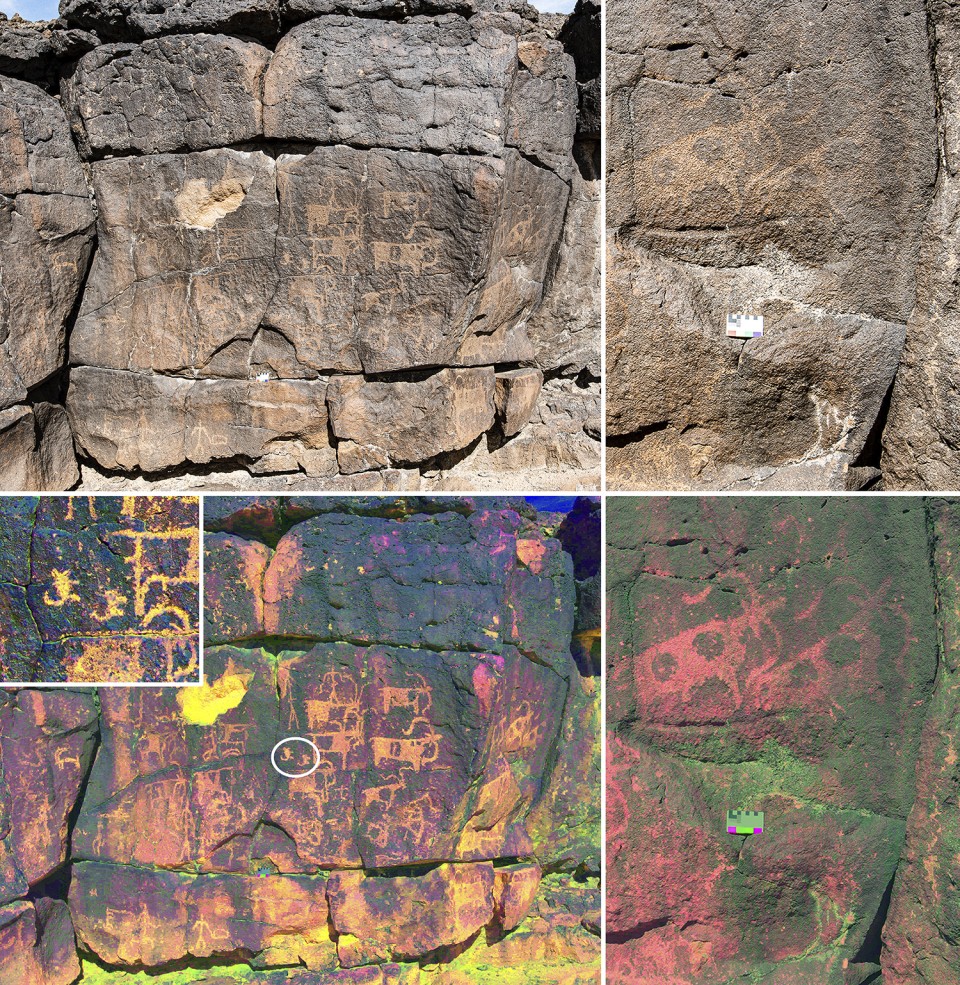
Neolithic rock art at Umm Jirsan showing herds, human figures, and dog engravings enhanced with DStretch

Panel 8 and 9 petroglyphs—mixed herds of sheep and goats, ibex, human figures, and simplified dogs with curled tails; DStretch ybk enhancement.

These findings underscore the immense potential for interdisciplinary investigations in caves and lava tubes, offering a unique window into Arabia's ancient past.

Michael D. Petraglia
Umm Jirsan lava tube—entrance views, vast interior passages, Jebel Abyad obsidian landscape, and plan showing Trench 1 excavation in Area C.Harrat Khaybar, northwestern Saudi Arabia · Stewart et al. / PLOS ONE 2024

In plain termsA Maastrichtian pterosaur from Jordan — flying reptile of the Late Cretaceous.

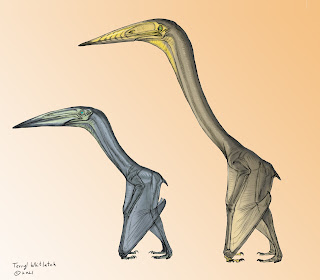
Life restoration of Inabtanin alarabia and Arambourgiania philadelphiae azhdarchoid pterosaurs standing quadrupedally

Journal of Vertebrate Paleontology · September 2024

Inabtanin alarabia

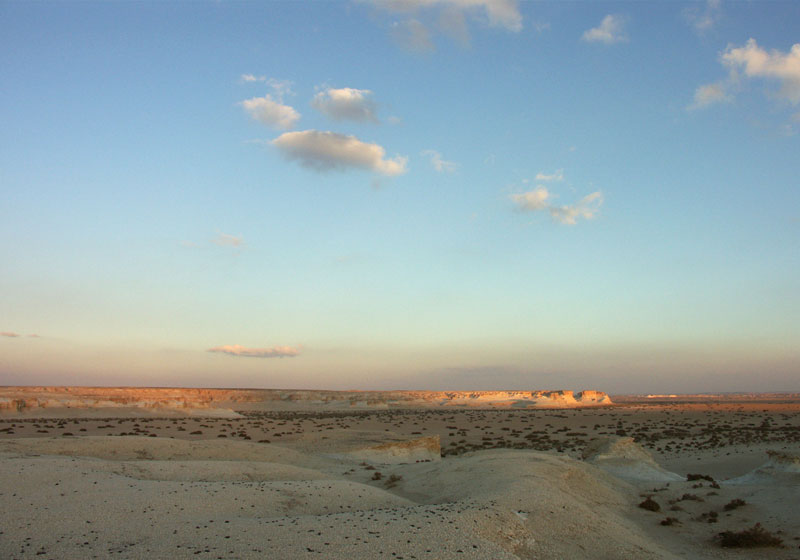
Tal Inab, Jordan · Maastrichtian · Upper Cretaceous

Grape-dragon (inab + tanin) from Tal Inab · alarabia references the Arabian Peninsula

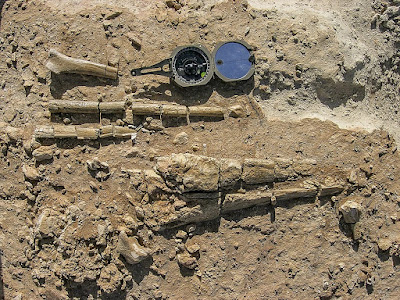
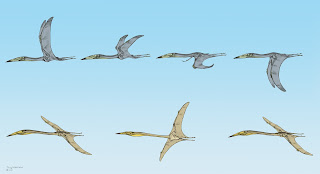
Two large azhdarchoid pterosaurs with three-dimensionally preserved wing elements from Jordan—Inabtanin alarabia (~5 m wingspan) and Arambourgiania philadelphiae (~10 m)—reveal contrasting flight mechanics via micro-CT of humeral internal structure. Iyad S. Zalmout co-authored the study with Kierstin Rosenbach, Danielle Goodvin, Jordanian colleagues, and Jeffrey A. Wilson Mantilla—comparing micro-CT scans of humeri from Inabtanin alarabia and Arambourgiania philadelphiae to extant birds.

  • First new Jordan pterosaur species in decades—Inabtanin alarabia
  • Hollow strut morphology in Inabtanin—like flapping birds
  • Helical cortical ridges in Arambourgiania—like soaring birds
  • Rare 3D-preserved pterosaur wing bones from Afro-Arabia
  • Named for Tal Inab (grape hill) geomorphology near the locality

Wing to Dragon

Drag across the in-situ wing elements to reveal the grape-dragon of Tal Inab beside its giant soaring relative.

Life restoration of Inabtanin alarabia and Arambourgiania philadelphiae azhdarchoid pterosaurs standing quadrupedally

Terryl Whitlatch © 2021

Three-dimensionally preserved pterosaur wing bone elements in situ at Tal Inab, Jordan, with Brunton compass for scale

Rosenbach et al. / JVP 2024

Desert StrataTethys Ocean
Comparison of flapping flight in Inabtanin alarabia versus soaring flight in Arambourgiania philadelphiae
Micro-CT internal bone structure links Inabtanin to flapping birds (hollow struts) and Arambourgiania to soaring birds (helical cortical ridges).Rosenbach et al. / JVP 2024
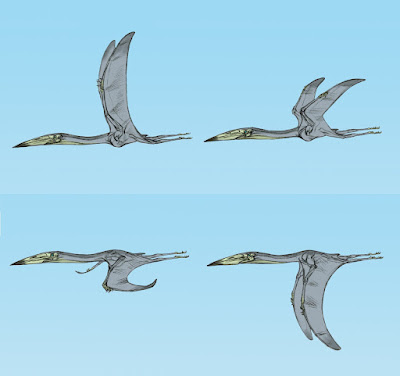
Four-panel sequence showing Inabtanin alarabia wing-flap cycle with skeletal overlay

Powered flapping inferred for Inabtanin—internal humeral morphology most similar to extant flapping birds.

Tal Inab, Jordan · Rosenbach et al. / JVP 2024 · Artwork: Terryl Whitlatch © 2021

In plain termsFour-legged early whales from Jordan — before the full move to the sea.

Qaa Faydat Ad-Dahikiya canyon in the eastern Jordan desert—limestone cliffs rising above aromatic desert shrubs in the valley bed

Khammash Architects · The Jordan Times Weekender · September 2002

Walking Whales

Basilosaurus isis · Qaa Faydat Ad-Dahikiya · 1998

In the eastern Jordan desert, Jordanian paleontologists Dr. Hakam Mustafa of Yarmouk University and PhD student Iyad Zalmout uncovered the first Eocene marine mammal from Jordan—14 caudal vertebrae of Basilosaurus isis from a grey organic-rich cliff layer at Ad-Dahikiya.

  • 14 caudal vertebrae of Basilosaurus isis after cleaning
  • Grey organic-rich cliff layer yielded shark teeth and bone fragments
  • First Eocene marine mammal from Jordan
  • Matches archaeocete fossils across Egypt, Jordan, and Pakistan
  • Tethys paleo-shoreline across northern Arabia and the Levant
  • Fieldwork with Hakam Mustafa at Yarmouk University, 1998
Age
4045 Ma
Canyon
8 km
Cliff drop
40 m
Specimen
14 caudal vertebrae

Within the golden ochre of the desert land it appears like a fresh brushstroke in titanium white. In a brusque edge, the land drops some 40 meters leaving you suspended on a cliff—you've reached the edge of a flying carpet.

Ammar Khammash
Eroded limestone cliff faces at Ad-Dahikiya with horizontal stratification and golden-hour light

Forensic stratigraphy · Eocene

Like detectives or forensic experts, they piece together evidence of life and death in the remote past—events that happened some 45 million years ago. Using picks and brushes, Dr. Hakam Mustafa and Iyad S. Zalmout collected specimens from the cliff layer—wrapping finds in soft tissue and marking bags with location readings.

Cylinder-shaped stones slightly bigger than a soft drink can, recognized within a lump of earth, were immediately identified as fossilized bones of a large vertebrate—the ever-growing files of the two scientists' mental zoos were double-clicked open.

First marine mammal from the Eocene of Jordan. After cleaning, the vertebrae matched Basilosaurus isis archaeocete material from Egypt to Pakistan—confirming Jordan's place on the Tethys paleo-shoreline.

The cliff face where Hakam Mustafa and Iyad Zalmout searched grey organic-rich strata for shark teeth and archaeocete bone fragments during 1998 fieldwork.

Image: Ammar Khammash · Khammash Architects · Ad-Dahikiya, Jordan

Tethys paleo-shoreline

On these paleo-shorelines, whales walked and swam in a wider habitat reaching from Egypt to Pakistan—when the Tethys Ocean linked the Arabian Gulf with the Mediterranean, submerging most of northern Jordan and almost all of Syria.

Ad-Dahikiya's titanium-white limestone cliff drops 40 meters from the desert floor—an enclosed valley walled by parallel faults, where grey organic-rich layers preserve Eocene marine fossils.

GPS
N 31°37.200′ · E 37°07.000′
Institutions
Yarmouk University · University of Michigan
Qaa Faydat Ad-Dahikiya canyon in the eastern Jordan desert—limestone cliffs rising above aromatic desert shrubs in the valley bed

In plain termsA foot-powered swimmer from Egypt's Valley of the Whales.

Paleontologists Dan Paleczny and Iyad Zalmout at the Aegicetus site in Wadi Hitan when excavation began in 2007

Nature Middle East · 11 December 2019

A whale of a tail

Aegicetus gehennae · 2007 · Qaret Gehannam

Fossilised remains of a newly identified whale from Egypt represent the evolutionary step from foot-powered to tail-powered swimming—a nearly complete late protocetid unearthed at Wadi Al Hitan by Philip Gingerich, Mohammed Antar, and Iyad Zalmout.

  • Transitional protocetid between foot-powered and tail-only swimmers
  • Hips decoupled from spine—unfused sacrum, more flexible mid-body
  • Elongated body and tail; smaller hind limbs than earlier archaeocetes
  • Undulating midsection and tail; steering with forelimbs, no broad tail fluke
  • Almost complete spine, partial skull, and pieces of arms and legs
  • Species new to Wadi Al-Hitan—between otter-like paddlers and Basilosaurus
Length
3.6 m
Weight
~890 kg
Age
~39 Ma

We believe it swam with an undulating motion of its mid-body and tail, rather like a modern eel or crocodile. It was definitely less of a foot-powered swimmer than its ancestors.

Philip D. Gingerich
Mohammed Sameh Antar supervising the Aegicetus gehennae excavation at Qaret Gehannam, Wadi Al-Hitan, 2007

Smithsonian Magazine · 11 December 2019

Ancient Whale Fossil Helps Detail How the Mammals Took From Land to Sea

By Riley Black

A 39-million-year-old whale with floppy feet helps illuminate the transition to the oceans. In 2007, University of Michigan & Egyptian Environmental Affairs Agency, 2007 explored an uncharted sector of Whale Valley—and caught a partial skeleton weathering out of Qaret Gehannam.
One paleontologist spotted a cluster of vertebrae weathering out from the foothill of a prominent plateau known as Qaret Gehannam, and even more fossilized bones appeared to be going into the rock. The experts had arrived at just the right time to catch the whale, recently exposed by the weathering of the foothill.

Iyad S. Zalmout

Mohammed Sameh Antar (third from left) supervising the 2007 excavation at Qaret Gehannam—the foothill where vertebrae weathered out of the rock just as the U-M and Egyptian Environmental Affairs Agency team arrived.

Image: Philip Gingerich · Qaret Gehannam, Wadi Al Hitan, Egypt
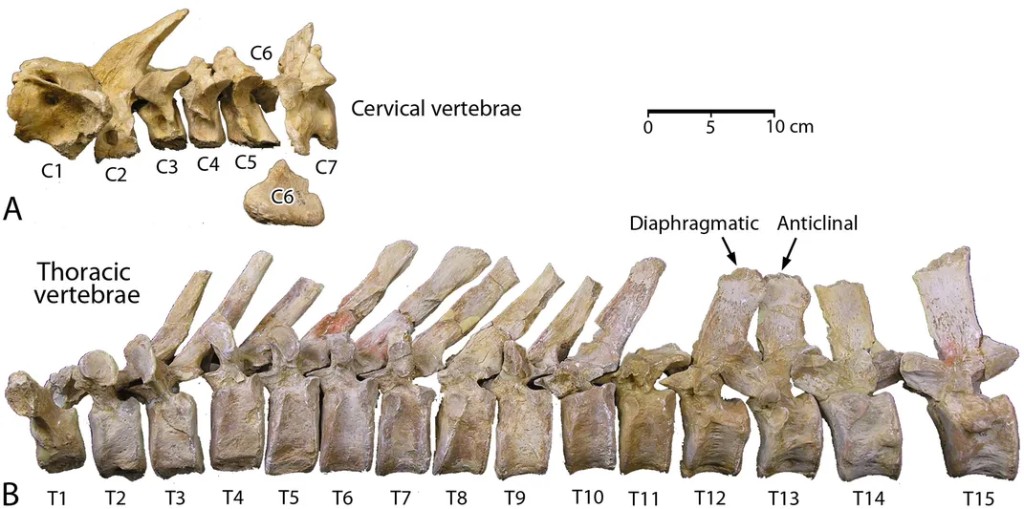
Cervical (C1–C7) and thoracic (T1–T15) vertebrae of Aegicetus gehennae holotype with diaphragmatic and anticlinal vertebrae labeled

PLOS ONE · Hip–spine decoupling

The earliest whales had hips fused to the spine like terrestrial mammals. In Aegicetus gehennae, the sacrum unfused and the hind limbs lost their weight-bearing role—whales could no longer paddle with their legs and relied on undulating their spines through the water.

I'd say this fossil is another excellent piece of the puzzle of the lineage of whales that went from terrestrial to fully aquatic.

Mark Uhen, George Mason University

Cervical and thoracic vertebrae—elongated body and tail, smaller hind limbs, and no firm hip–spine connection indicate a more fully aquatic, less foot-powered swimmer than its ancestors.

Image: Gingerich et al. · PLOS ONE
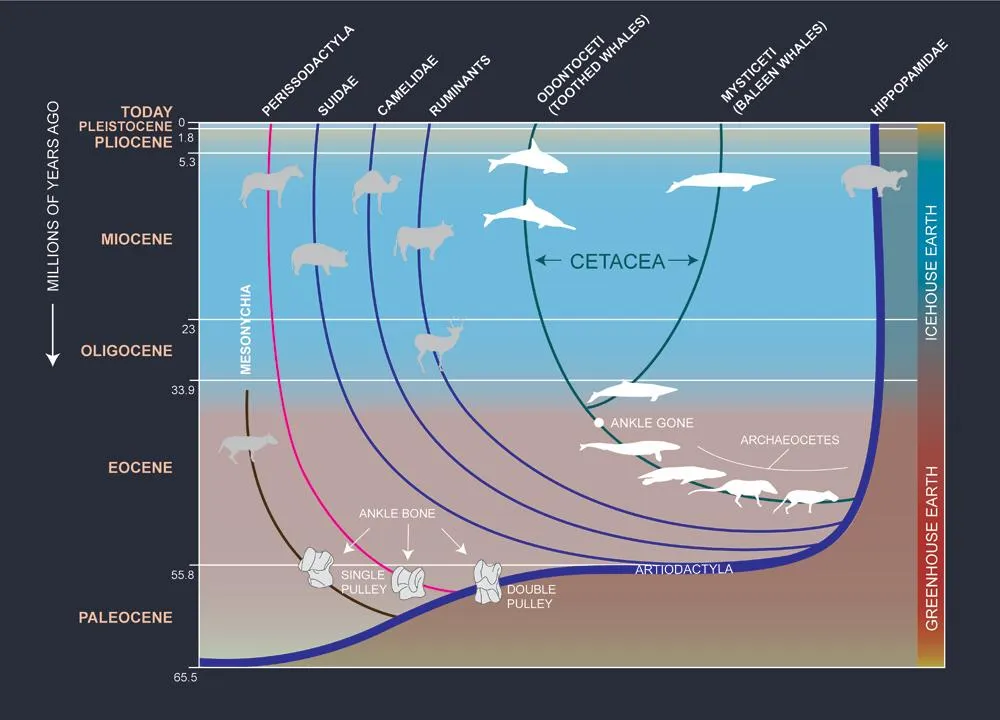
Diagram of whale evolution from terrestrial ancestors through archaeocetes to modern odontocetes and mysticetes, with greenhouse to icehouse Earth transition

Land to sea · Branching bush, not a straight line

Early whale evolution was a branching bush of amphibious forms— many extinct, some increasingly aquatic. Aegicetus gehennae sits between otter-like paddlers and fully tail-driven swimmers like Basilosaurus, undulating its midsection while steering with forelimbs, without the broad tail fluke of modern cetaceans.

Every time we find a complete and articulated whale of a new species there would be more thinking and digging than before.

Iyad S. Zalmout

For every question a fossil answers, more arise, which keeps our lives interesting!

Mark Uhen, George Mason University

Whale evolution from land to sea—archaeocetes branch from artiodactyl ancestors as ankles disappear and tail-powered locomotion emerges in the Eocene–Oligocene transition.

Image: Mary Parrish · Smithsonian Institution

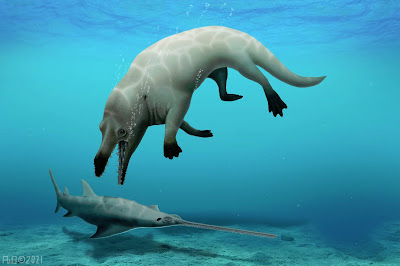
In plain termsAn Egyptian protocetid whale named for the jackal-headed god Anubis.

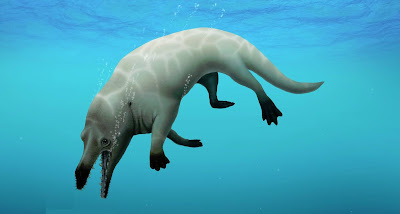
Phiomicetus anubis diving toward prey in an Eocene marine environment

Proceedings of the Royal Society B · 26 August 2021

Phiomicetus anubis

Gehannam Formation · Middle Eocene · Lutetian · Gehannam Formation, Fayum Depression, Egypt

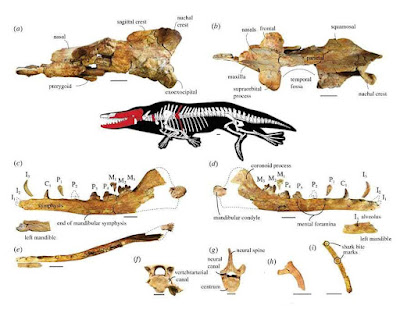
A new medium-sized protocetid preserving skull and mandible reveals a strong raptorial feeding style—and nests as the most basal protocetid known from Africa, co-occurring with the remingtonocetid Rayanistes afer. Iyad S. Zalmout co-authored the description with Abdullah Gohar, Mohammed Antar, Robert Boessenecker, Erik Seiffert, and Hesham Sallam—recovering Africa's most basal known protocetid from the same bed as Rayanistes afer.

  • Most basal African protocetid in phylogenetic analysis
  • Enlarged temporal fossae and raptorial jaw mechanics
  • Co-occurrence with remingtonocetid Rayanistes afer in same bed
  • First clear evidence both families shared African ecosystems
  • Four webbed limbs—semi-aquatic stage of whale evolution

Fossil to Predator

Drag across the holotype cranium and mandible to reveal the living protocetid hunting in the Eocene Tethys.

Artistic reconstruction of Phiomicetus anubis swimming underwater with four webbed limbs

Abdullah Gohar © 2021

Fossil cranium, mandible, and vertebrae of Phiomicetus anubis with skeletal silhouette

Gohar et al. / Proc. R. Soc. B. 2021

Desert StrataTethys Ocean
Map of Egypt showing Phiomicetus anubis discovery site in the Fayum Depression
Discovery site in the Gehannam Formation, Fayum Depression—where Eocene strata preserve Africa's earliest protocetid whales.Gohar et al. / Proc. R. Soc. B. 2021 · Western Desert, Egypt
Composite figure showing Phiomicetus anubis life restoration, Fayum map, and fossil elements
From desert outcrop to living predator—Phiomicetus augments understanding of biogeography and feeding ecology in early cetacean evolution.Artwork: Abdullah Gohar © 2021 · Figure: Gohar et al. / Proc. R. Soc. B. 2021
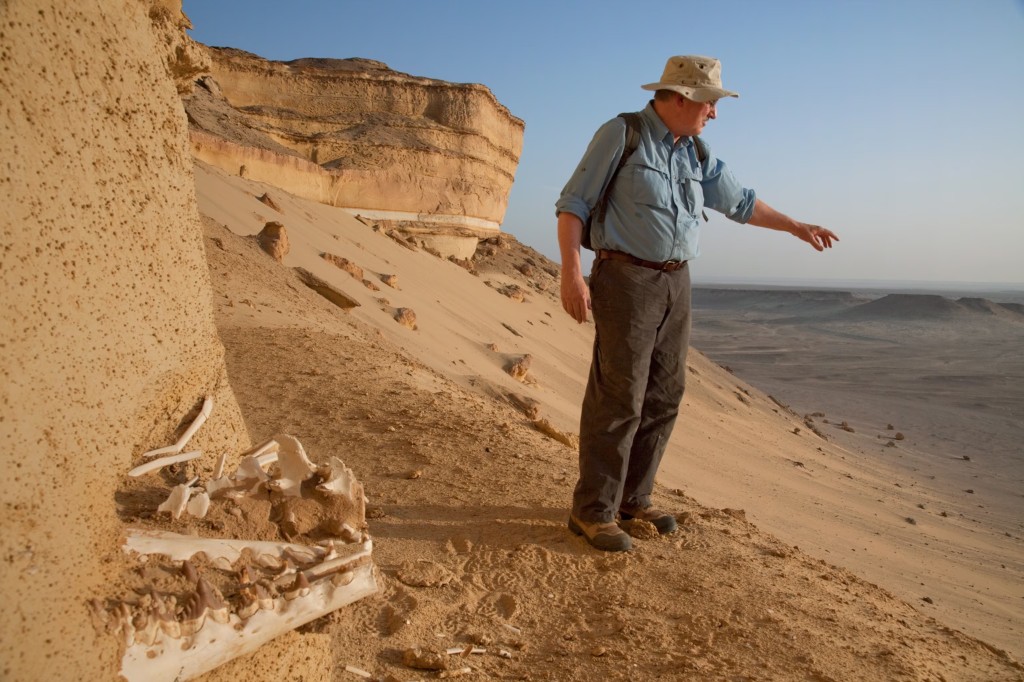
Philip Gingerich at Wadi Hitan pointing toward the desert valley where Basilosaurus fossils emerge from Eocene strata

National Geographic Magazine · August 2010

Valley of the Whales

An Egyptian desert, once an ocean, holds the secret to one of evolution's most remarkable transformations.

By Tom Mueller · Photographs by Richard Barnes · 20 min read

In Egypt's Valley of the Whales, Philip Gingerich and his team have mapped more than a thousand Eocene whale skeletons. Jordanian postdoc Iyad Zalmout excavated a whale rostrum from a cliff face with Ryan Bebej—while in Pakistan he had already found the Artiocetus anklebone that proved whales descended from artiodactyls.

  • Basilosaurus retained vestigial hind legs with knees, ankles, and toes
  • Wadi Hitan yielded more than a thousand whale fossils over 27 years
  • Pakicetus to Basilosaurus documents land-to-sea metamorphosis
  • Whale evolution as Darwin's most elegant proof—not creationist refutation

Complete specimens like that Basilosaurus are Rosetta stones. They tell us vastly more about how the animal lived than fragmentary remains.

Philip D. Gingerich
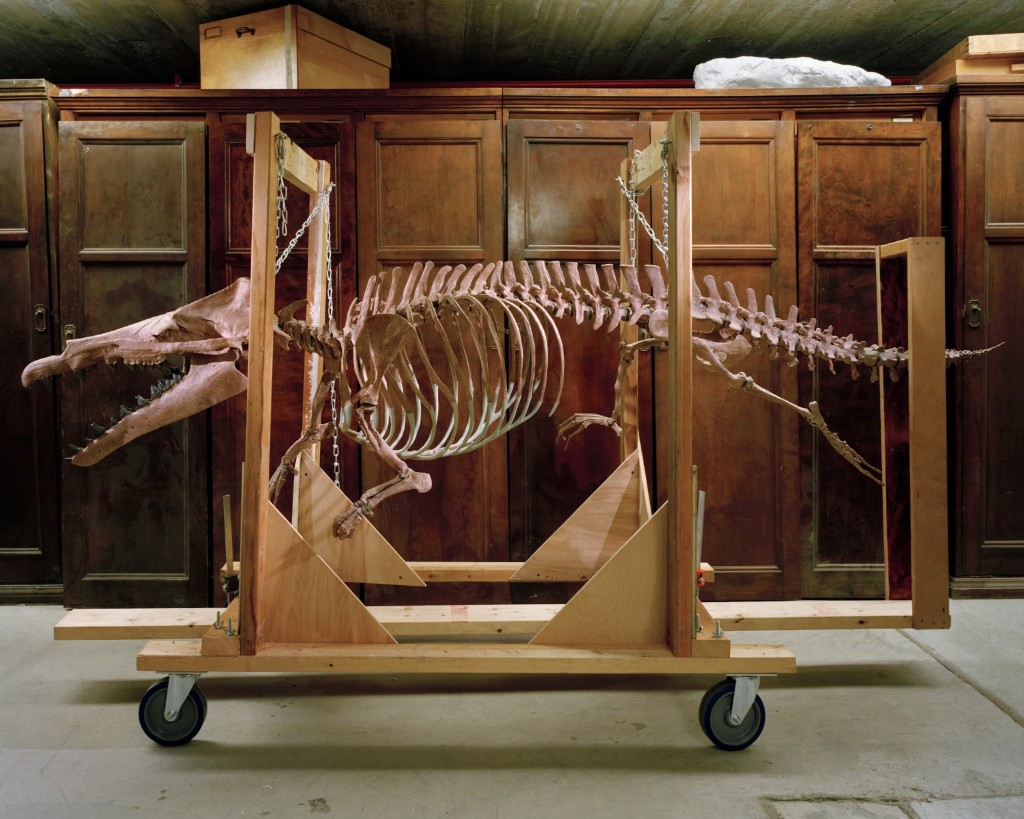
Basilosaurid whale skeleton mount showing vestigial hind legs with knees and toes

It isn't every day that you see a whale's leg.

Basilosaurus retained delicate hind legs—complete with knees, ankles, and toes—useless for walking but crucial evidence that whales descended from land mammals.

In Pakistan in 2000, graduate student Iyad Zalmout found a grooved anklebone among the remains of a new 47-million-year-old whale—Artiocetus—confirming whales descended from artiodactyls, not mesonychids.

Desert photo: Richard Barnes / National Geographic · November 2009

In plain termsFossil evidence of one whale preying on another in Eocene Egypt.

Iyad Zalmout at a Basilosaurus jaw excavation in the Valley of the Whales, Egypt

SBS News · 10 January 2019

Scientists find remains of a whale inside bigger whale

Basilosaurus isis · Wadi Al Hitan (Valley of the Whales), Egypt · ~35 Ma

Stomach contents of a 15-meter Basilosaurus isis from Egypt's Valley of the Whales reveal apex predation—sharks and large bony fish, but predominantly bones of the smaller archaeocete Dorudon atrox. Jordanian palaeontologist Iyad Zalmout helped excavate remains in Egypt's Valley of the Whales—a shallow late Eocene sea where the 15-meter predator fed predominantly on Dorudon atrox.

  • Whale-on-whale predation ~35 million years before orcas
  • Bite marks on prey skulls—live hunting, head-first attacks
  • Shallow Tethys may have been a Dorudon nursery and hunting ground
  • Compared to modern killer whale feeding on smaller whales and calves
  • Strengthens evidence Basilosaurus was an apex marine predator
Iyad Zalmout points to carnivorous whale teeth exposed in Wadi Hitan desert strata

Wolves of the sea · 35 million years before orcas

Iyad Zalmout examines the serrated dentition of a late Eocene carnivorous whale—teeth that would later yield stomach contents documenting whale-on-whale predation.

Scientists compared Basilosaurus isis to modern killer whales—apex hunters that attack smaller cetaceans and calves in shallow nursery waters.

Wadi Al Hitan, Egypt · AAP · AAP / SBS News

In plain termsCenozoic fossil prospecting on Madagascar with Karen Samonds and colleagues.

Northern Illinois University · 2005 · 2010 · 2011 · 2014

Madagascar Field Seasons

Cenozoic fossil prospecting with Karen Samonds, Mitch Irwin, and Malagasy colleagues across Ampazony, Katsepy, and Nosy Mahakamby.

Field seasons searched unexplored Cenozoic exposures for fish, sharks, crocodiles, turtles, sirenians, bats, and lizards—filling Madagascar's 65-million-year fossil gap. Iyad Zalmout joined expeditions prospecting beaches, waiting for ferries, and collecting alongside Mitch Irwin, Lydia Raharivony, Zizy Rakotomalala, and the wider Malagasy–NIU team.

  • First sirenian skull from Madagascar (Ampazony, 2003)
  • Beach prospecting near Katsepy and Mitsinjo
  • Open-ocean camp on Nosy Mahakamby
  • National Geographic–supported Cenozoic research
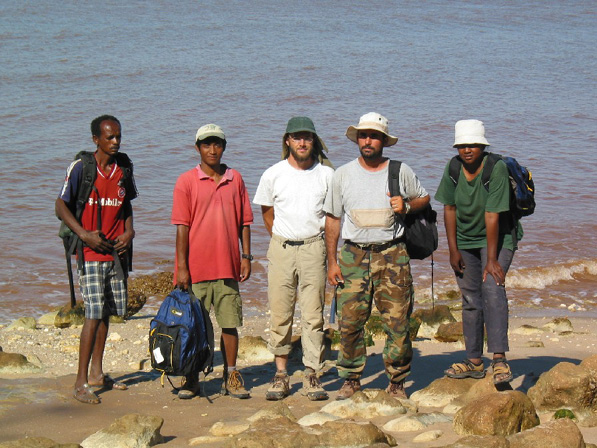
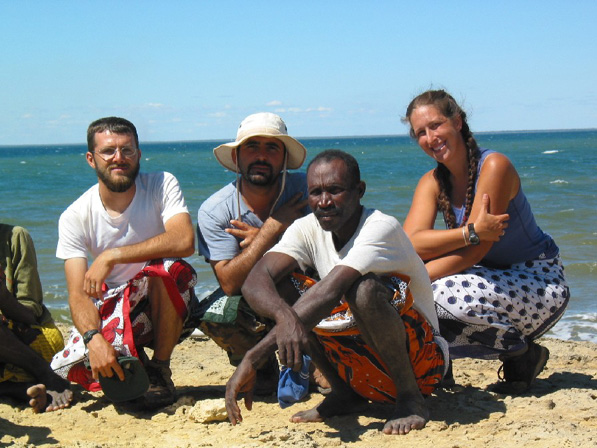
Field team on the shores of Katsepy including Iyad Zalmout, Mitch Irwin, and Lydia Raharivony

On the shores of Katsepy—Lava, Jean-Luc, Mitch, Iyad, and Lydia after beach prospecting for Cenozoic fossils.

Katsepy, Madagascar

Karen Samonds fieldwork archive

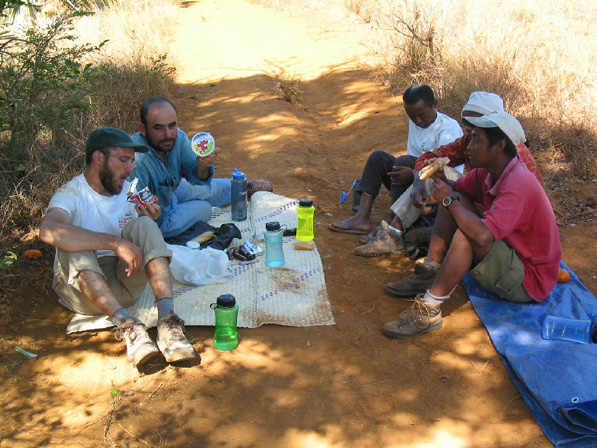
Field team lunch on the dusty road to Mitsinjo including Mitchell Irwin and Iyad Zalmout

Lunch on the long dusty road to Mitsinjo—Mitchell Irwin, Iyad Zalmout, Claude, Lydia, and Jean-Luc Raharison.

Mitsinjo road, Madagascar

Karen Samonds fieldwork archive

Iyad Zalmout, Lydia Raharivony, and Zizy Rakotomalala waiting for the ferry to Katsepy, Madagascar

Waiting for the ferry across the Betsiboka—no regular schedule, just patient field time en route to Katsepy camp.

Katsepy, Madagascar

Karen Samonds fieldwork archive

Ancestors ceremony on Nosy Mahakamby with Mitch Irwin, Iyad Zalmout, Charlin, and Karen Samonds

Ancestors ceremony on Nosy Mahakamby—Mitch, Iyad, Charlin, and Karen on the island camp ~4 km offshore.

Nosy Mahakamby, Madagascar

Karen Samonds fieldwork archive

Field camps

  • AmpazonyFirst camp since 2001; produced Madagascar's first sirenian skull in 2003.
  • KatsepySecond camp across the Betsiboka—ferry waits, beach prospecting, and shore exposures.
  • Nosy Mahakamby~4 km offshore; ancestors ceremony, tide-limited collecting on a 1.5 km island.

In plain termsDesert-to-ocean slider — Wadi Hitan today versus the ancient Tethys Sea.

Excavation X-Ray

Drag the stratigraphic veil between Wadi El Hitan's desert pavement and the Tethys Ocean that once submerged these archaeocete giants.

Basilosaurus cetoides skeletal mount — Tethys Ocean reconstruction

Basilosaurus mount · Smithsonian NMNH

Iyad Zalmout examining archaeocete vertebrae in Wadi Hitan desert strata

Field excavation, Wadi Hitan

Desert StrataTethys Ocean

Explorer

Press & Media Kit

Copy-ready bios, quotes, and assets for journalists and conference organizers.

Press & Media Kit

Invitations welcome

  • Invited talks on Afro-Arabian paleontology, hominin dispersal, and whale evolution
  • Field collaborations in Saudi Arabia, Egypt, Jordan, and the wider Afro-Arabian region
  • Media interviews on Saadanius, Al Wusta, Wadi Hitan archaeocetes, and Green Arabia research
  • Grant partnerships, museum exhibitions, and university guest lectures

Short bio · ~80 words

Dr. Iyad Zalmout is Research Director and Consultant at the Saudi Geological Survey Paleontology Section and Research Affiliate at the University of Michigan Museum of Paleontology. A National Geographic Explorer since 2009, he co-discovered the Oligocene stem catarrhine Saadanius hijazensis (Nature, 2010) and has authored 81 publications on Afro-Arabian vertebrate paleontology, archaeocetes, and human dispersal.
Long bio · press release

Dr. Iyad Zalmout (PhD, Vertebrate Paleontology, University of Michigan) serves as Research Director at the Saudi Geological Survey Paleontology Section in Jeddah and as Research Affiliate at the University of Michigan Museum of Paleontology. His fieldwork spans Saudi Arabia, Egypt, Jordan, Pakistan, and Madagascar — from the 2009 discovery of Saadanius hijazensis in the Shumaysi Formation to Homo sapiens remains at Al Wusta (2016), Eocene whale graveyards in Al-Jouf (2021), and lava-tube archaeology at Umm Jirsan (2024). He has been a National Geographic Society Explorer since 2009. ResearchGate: 78,138 reads · 3,097 citations.
Quotable

  • Within minutes, I found teeth sticking out of the ground, and when I realized what they were I was shocked.

    On discovering Saadanius · Phys.org, 2010
  • We knew it was important. It was the first direct evidence of any large primate or hominid life in the area.

    On Al Wusta · SAPIENS, 2020
  • This new whale is similar in size and morphology to the partial skeleton found in the western desert of Egypt… the new material from Saudi Arabia is more complete.

    On Al-Rashrashiyah archaeocete · Arab News, 2021

Explorer

CV & Downloads

One-page research summary for committees and reviewers, plus links to full publication records.

Explorer

Global Field Globe

Twelve localities across five countries — filter by region, expand a country to see its sites, and hover pins for details.

Showing 12 of 12 localities

Drag · hover pin for info

Explorer

Curated Expeditions

Guided paths through discoveries — thematic routes that link related sections.

Explorer

Publications Explorer

Filter 81+ works by research theme or search by title, journal, and year.

Publications Explorer

Contact

Dr. Iyad Zalmout

zalmouti@umich.edu734.764.0489

Museum of Paleontology

Biological Sciences Building1105 North University AveAnn Arbor, MI 48109-1085

Research Museum Center (RMC)

3600 Varsity DriveAnn Arbor, MI 48108

Discovery stories, field sites, and full publication links live in the sections above — use the top nav, search, or All sections to jump anywhere.

Profile data from U-M Museum of Paleontology and ResearchGate. Imagery: Saadanius holotype videoscan (Julia Fahlke / Iyad S. Zalmout, Wikimedia Commons, CC BY-SA 3.0); Saadanius skull views (Iyad S. Zalmout, Wikinews); Saadanius field photo (U-M Museum of Paleontology); Al Wusta phalanx (Ian Cartwright / Palaeodeserts Project); Wadi El Hitan fossil (Wikimedia Commons, CC BY-SA); Basilosaurus field photos (AAP / SBS News); Basilosaurus mount (Quadell, Wikimedia Commons, CC BY-SA).

Designed and developed by Unais Ali